How Long Does Firewood Take to Season? (By Species and Split Size)
Most split hardwoods need 6 to 12 months of real drying weather. Oak needs 18 or more, ash can be ready in 6, and the reason no two guides agree is that green moisture is a tree number more than a species number. This is what we measure coming off our own loads, and how to tell when yours is ready to burn.
Every fall we take the same phone call. Someone split their wood in April, stacked it, watched it sit through a hot Wisconsin summer, and now they want to know how much more they need to get through winter. The answer is usually more than they hoped, because the wood they already have is not ready.
That call is the reason this guide exists. Most seasoning advice online says split in spring, burn in fall. It is not bad advice. It is just written for a different climate than ours, and it skips the part that actually decides the answer.
Most split hardwoods need 6 to 12 months of real drying weather.Oak needs 18 months or more. Ash can be ready in 6. Those ranges assume split wood, stacked off the ground, in a climate with a genuine drying season.
Firewood Seasoning Time by Species
Green moisture below shows typical USDA values for freshly felled wood, measured as a percentage of oven-dry weight. Air-seasoning times assume split wood, stacked off the ground, top covered with the sides left open, in an Upper Midwest climate.
Species
Green moisture (USDA, oven-dry basis)
Air season, split
Notes
Ash, standing dead
Not applicable, already drying
4 to 8 months
Starts drier than anything else that comes through our yard.
Ash, live cut
44 to 58
6 to 9 months
Fastest of the live-cut hardwoods, by a wide margin.
Cherry
58
6 to 12 months
Seasons well once split. Ready earlier than most hardwoods.
Soft maple, red and silver
58 to 97
6 to 12 months
Still a true hardwood. Dries mid pack.
Hard maple, sugar
65 to 72
12 to 18 months
Carries nearly the same water as white oak. Runs on an oak clock.
Hickory
52 to 70
12 to 18 months
Dense and slow, on roughly the same clock as hard maple.
Birch
70 to 89
8 to 12 months
Bark seals it tight. Has to be split or it will not dry.
White oak
64 to 78
18 to 24+ months
Denser than red oak and slower to give up water.
Red oak
69 to 80
18 months typical
The slowest common hardwood, and the one people misjudge most.
Green moisture ranges come from the USDA Forest Products Laboratory Wood Handbook, Table 4-1, and cover heartwood and sapwood of the common species in each group. Moisture content in wood is expressed as a percentage of oven-dry weight, which is why green wood can exceed 100%.
Boxelder deserves one line: maple family, softwood behavior, dries fast, very little heat. It burns. It just will not carry a fire overnight.
This chart is about time, not heat. If you are deciding what to burn rather than when it will be ready, our guide to the best firewood to burn ranks these same species by heat output.
Why One Wisconsin Summer Is Usually Not Enough
Wood does not dry toward a fixed number. It dries toward balance with the air around it, set by temperature and humidity together, and it stops where the air tells it to stop.
Same heat, same wood, ten points apart.At 80 degrees, wood sitting in 30 percent humidity settles at roughly 6 percent moisture. The same wood, same temperature, in 80 percent humidity settles at roughly 16. That difference is humidity alone. (USDA Wood Handbook, Table 4-2.)
That is the difference between a Wisconsin July and a July in Arizona or west Texas, and it is why advice written in a dry climate falls apart here. Dry air wins twice: it pulls harder, so wood dries faster, and it pulls further, so wood finishes lower. Our summers give you the heat and take away the gradient.
The research lines up. A Cold Climate Housing Research Center study in bone-dry Fairbanks got split wood burnable in six weeks to three months over one summer. A University of Maryland study in a humid climate closer to ours found every species still between 20 and 26 percent by November, six and a half months in, with only black locust and black cherry actually ready. Our own yard says the same: wood set out in late spring was still not there when we got back to it at the end of October.
When to split so it is ready
Work backward from the night you want to burn it, not forward from the day you split.
Ash and cherry: split by early spring for the same winter. These are the only common species where one season is realistic here. More in our cherry firewood guide.
Birch and soft maple: split in early spring and plan on the following winter. You may get there by late season, but do not build your winter around it.
Hard maple and oak: split now for the winter after next. Oak split this April is next winter's wood at the earliest, and the winter after that if it is white oak.
Wood split after midsummer will not make the coming winter.You have handed back the only stretch of weather doing real work. Winter air is dry, but it is cold, and cold air moves almost no water. The Fairbanks study found fall-cut wood did not cure by spring under any storage method they tried, and some tarped samples finished wetter than they started.
Why Every Answer You Find Online Is Different
Sources disagree on this question because the wood is not the same wood, and almost nobody says what they started with. Green moisture is not really a species number, it is a tree number. The USDA Wood Handbook lists white ash at 46, green ash at 58 and black ash at 95. Same genus, more than double the spread, and the handbook says outright that values vary considerably between specimens of the same species. So when a site tells you oak is exactly 60 percent green, that number is doing less work than it appears to be.
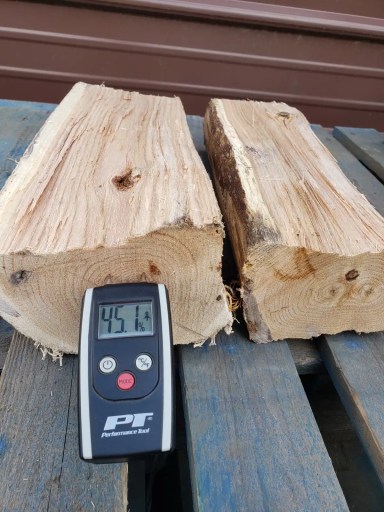
Red oak, fresh split | The meter displayed 45.1%, but readings this high are only approximate.
There is a second thing that trips up anyone holding a new meter. Split a fresh oak round, press the pins in, and you may see something in the forties, nowhere near the sixty to eighty the handbook lists. Nothing is broken. Pin meters are most reliable between roughly 7 percent and fiber saturation, which sits around 30 percent. Past that point, additional water changes the electrical resistance less and less, so the displayed number becomes increasingly unreliable. So 45 percent displayed on fresh oak is not its actual moisture content. It means the wood is beyond the meter's reliable range. Reading a meter correctly matters more than which meter you bought.
That is why our fresh-wood readings are useful as comparisons, not exact moisture values. We metered live ash at 30.5, and two red oak splits at 45.1 and 47.1, all off fresh-cut loads from living trees. Those readings follow the same pattern we see in the USDA data, truck weights, and kiln cycles: oak arrives wetter than ash. The meter does not tell us by how much.
How we know which species carries more water
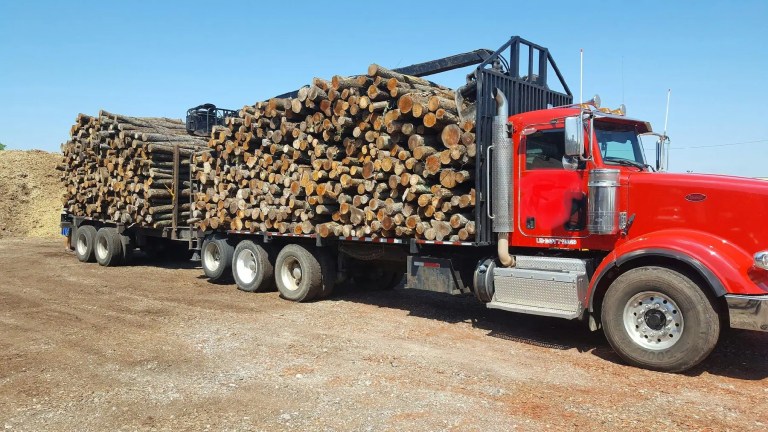
The clearest evidence we have on this does not come from a meter at all. It comes off a truck scale. Our semi loads run to a 96,000 pound gross limit, and what changes load to load is how many cords fit under that ceiling. Oak fills the truck at about 12 cords. Ash takes 14 or 15. Standing dead ash reaches 16. Same truck, same weight, four more cords, and the primary difference is water.
Inbound log load | Oak fills a truck at about 12 cords. Ash takes 14 or 15
Fewer cords on the same truck means heavier wood, and the extra weight is mostly water.That beats any single meter reading because it averages thousands of pieces instead of testing one spot on one log. It works in reverse too: a hard maple load that comes in at 15 cords when it usually runs 12 or 13 has been down a while, and we adjust the kiln cycle for it.
You can use the same signal without a truck. Pick up a split. Green oak is startlingly heavy, and a cord sheds eight hundred to a thousand pounds of water before it is burnable. You will feel it.
How You Split It Matters More Than How Small
Think of wood as a bundle of tiny tubes running the length of the tree. Water sits inside them, and it gets out three ways that are nothing alike.
Out the cut ends. Wide open. The USDA measures this route at 10 to 15 times faster than any other.
Sideways through the split face. Open, but slow. Water has to work across the grain instead of along it.
Through the bark. Effectively closed. The tree grew it to hold water in, and it keeps doing that job long after the tree is down. Birch is the extreme case: leave a round unsplit and it will rot before it dries.
Cutting to 16 inches handles the first route, which is why short pieces beat four foot logs by a mile. But once every piece in your stack is the same length, the ends stop being the variable. What is left is the face.
So the question is not how big the piece is, it is how far the deepest water sits from an opening. Thicker pieces lose twice over: more water to remove, and a longer trip out for every drop of it, which is why the USDA's Dry Kiln Operator's Manual puts a doubling of thickness at three to four times the drying time rather than twice. That is why a big round barely dries. Maryland left live hickory in unsplit 16 to 18 inch rounds for a full year and it was still above 30 percent. It is also why a wide half round disappoints. It looks split, but water near the bark edge has a long slow crawl to the one face that is open.
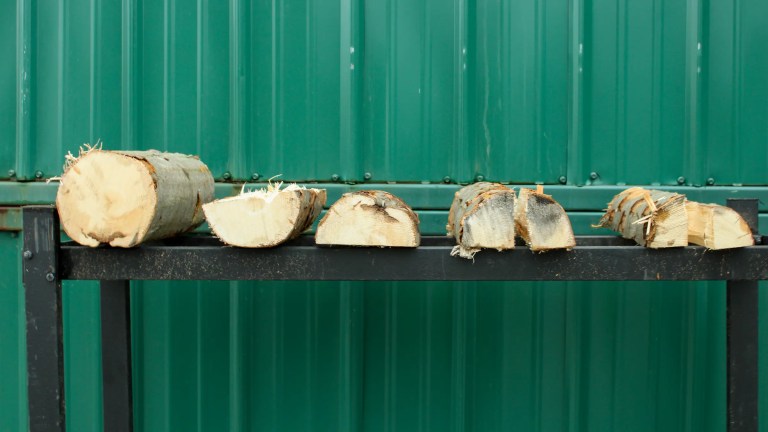
Same log, same 16 inch length | What changes is how much open face each piece has
The piece you want has two faces meeting at a corner. Most of its surface is open wood, the bark is down to a narrow strip, and nothing inside sits far from an opening. Take that same six inch round: whole, the deepest water sits eight inches from the nearest way out, because the only openings are the cut ends. Halve it and that drops to three inches. Split those halves into wedges and it is two. Keep going and it is barely one.
That is the whole argument in four numbers, and none of it is about the wood being smaller. It is about where you put the openings. Moving air through the stack then pays off in proportion to how much open face you gave it.
Why we run a kiln instead of just splitting everything small
Anybody can dry wood faster by splitting it tiny. The physics is on your side and it works. The problem shows up in the stove: a small split has more surface exposed to flame at once, so it lights fast, burns hot, and is gone. Fill a firebox with kindling-sized pieces and you will feed it all evening and burn through your stack twice as fast as you planned.
Sixteen way box wedge | Square faces, minimal bark curve, 2 by 2 to 3 by 3 inches
That is the tradeoff nobody mentions when they tell you to split smaller, and it is why we run a kiln. It lets us cut a sturdy piece, 2 by 2 to 3 by 3 inches off a sixteen way box wedge splitter, and still bring it to 15 percent moisture. You get the burn time of a real split and the dryness of a small one instead of choosing. That is the whole argument for kiln-dried firewood.
Oak and Ash: The Two Ends of the Range
Oak is the slow one for a reason. It comes off our splitter in the mid forties, higher than anything else we handle, and white oak resists moisture movement through its structure in a way red oak does not. Eighteen months is fair for red oak. White oak needs every bit of that and then some. Oak split in spring is not a candidate for the following winter no matter how well you stack it. More in our full oak firewood guide.
Ash is the fast one, and plenty of guides get this wrong by grouping it with oak at 12 to 24 months. That is not what we see. Ash comes off the same splitter, the same day, at around 30 percent while the oak beside it reads 45. Our kiln runs oak 36 to 42 hours and ash 26 to 30 in the same chamber, timed from the point every core probe reads 160 degrees, and that ratio holds in a stack outside just as it does in a controlled kiln.
Standing dead ash is its own category, and Wisconsin has a great deal of it thanks to emerald ash borer. That wood arrives already partway down: around 26 percent on our meter against low thirties for live cut, 16 cords to a truck against 14 or 15, and 22 to 24 hours in the kiln instead of 26 to 30. Three measurements, same story. Our ash firewood guide goes deeper.
Figure 3 | Standing dead ash measured against live cut on three independent checks at the yard.
Which points at something the charts miss. Wood starts losing moisture before you ever split it. A standing dead tree, a blowdown from two summers back, or logs bucked and decked last season are all partway there before you touch them. Splitting is what starts the fast part of the clock, not the clock itself.
This only holds for wood that dried standing or stacked clear of the ground.A log lying in the dirt does not dry, it rots. Ground contact feeds moisture back into the wood from underneath, and the Fairbanks study found unsplit wood left on the ground stayed wet and decayed rather than curing.
The Maple Problem
Maple causes more confusion than any other species here, and it is because two very different woods share the name.
Sugar maple, sold as hard maple, is nearly as dense as oak when it is green and carries almost the same water. On the USDA scale it lands right alongside white oak, and it fills our trucks at 12 to 13 cords, close to oak's 12. It runs on an oak clock: 12 to 18 months, sometimes longer.
Red maple and silver maple are sold as soft maple, and that name misleads people constantly. Soft maple is not a softwood. It is a genuine hardwood, harder than cherry, and it dries in the six to twelve month range like most of the middle of the pack.
So "maple takes as long as oak" is true only for sugar maple. Applied to a stack of silver maple it is wrong by a full year, and if you do not know which you have, weight will tell you first. Our maple firewood guide covers telling them apart.
How to Know It Is Ready
Everyone will tell you to buy a moisture meter and get under 20 percent. A meter is useful and we own several, but we do not decide with one. The same piece reads differently depending on where the pins go, a reading only means something on a face you just split open, and a piece reading higher than you would like can still burn beautifully. Too many variables sit inside one number for it to be the last word.
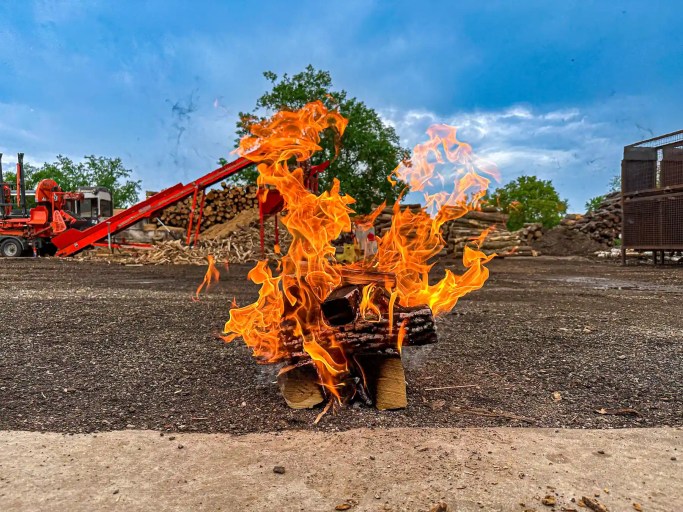
So we burn it. We stack a test pile in the yard like Lincoln logs, light it, and walk away. No poking at it, no rearranging, no help of any kind once it is lit. Wood that is ready catches and carries itself. Wood that is not tells you within minutes.
The test pile | Lit once, then left alone. Wood that needs help is not ready
You can run the same test at home. Light your fire the way you normally would, then leave it be. A fire you have to keep saving is telling you about the wood, not your technique. Dry wood also knocks together with a sharp crack instead of a dull thud and shows checking across the end grain. Our guide to what seasoned firewood actually means covers the rest of the checks.
We tested air drying properly once. About 20 cords of oak, ash, cherry and maple, set aside 9 to 12 months, then burned against our kiln-dried wood. Air drying does get wood burnable, and the ranges above are honest. What it never gave us was consistency: two pieces off the same stack could behave completely differently. We could not stand behind that, so we never sold air-dried wood at all.
Frequently Asked Questions
How long does it take for wood to season?
Most split hardwoods take six to twelve months of real drying weather. Ash and cherry can be ready in six. Oak takes eighteen months or more, and hard maple is close behind it. Softwoods run faster, three to six months, but give you less heat per piece.
How long does firewood take to dry?
Drying and seasoning are the same process under two names, so the same ranges apply. One distinction: if your question is about a stack that got rained on rather than wood that started green, that is a much shorter timeline and a different problem. We cover it in what happens when seasoned firewood gets wet.
Can you season firewood in three months?
In the Upper Midwest, only with a fast species split small and stacked in open air through the best of summer, and realistically only standing dead ash that started dry. Oak, hard maple and birch will not get there no matter what you do. In a hot dry climate the answer changes, which is exactly why so much online advice does not transfer.
Can firewood be seasoned too long?
Wood stops dropping once it reaches balance with the air, so there is no gain past that point, and after several years outdoors it decays and loses heat value. Well-stacked wood off the ground and under cover holds three or four years. Wood on the ground can be punky in one.
How do you know when firewood is seasoned?
Weight is the fastest check and it is free. After that: end checks, a sharp knock instead of a dull one, loosened bark, and a fire that carries itself without babysitting. To verify a specific piece, split it open and read the fresh face, not the weathered outside.
If the Timeline Does Not Work for This Winter
Seasoning is not complicated, but it is slow and the calendar does not negotiate. If you are reading this in September and your oak went on the stack in April, that wood is for next year.
That gap is why we run kilns instead of a woodlot. Our wood dries at 265 degrees to 15 percent moisture, USDA and Wisconsin DATCP certified, and it is ready the day it arrives. If you would rather season your own, split it early, split it right, and learn how to stack firewood so the wind can find it.
Winter closer than your woodpile is? Kiln-dried firewood, ready to burn the day it lands, delivered across SE Wisconsin.
Tyler Mainka is co-founder of Best Burn Firewood in New Berlin, Wisconsin, where he works directly in sourcing, processing, kiln-drying, packaging, and delivering firewood for residential and commercial customers. His writing is based on first-hand experience with wood species performance, moisture control, storage, and burn quality, including how different hardwoods behave in fireplaces, wood stoves, and outdoor fires. Tyler publishes practical guides to help customers choose the right firewood and burn it more safely, cleanly, and efficiently.
dry times for hardwoodfirewood season timetablehow long does firewood take to seasonlength of time to season woodseasoning timeframetime to season firewood