Can You Burn Pressure-Treated Wood? (Painted, Stained, Plywood, Pallets)
That pile of old deck boards looks like free heat, but treated wood is a different story. We checked the viral arsenic claims and found out what really happens when you burn it. One Wisconsin family learned the hard way, four winters in a row.
No, you can't safely burn pressure-treated wood. Not in a wood stove, a fireplace, a fire pit, an outdoor wood boiler, or a burn pile, and it doesn't matter whether the boards are 40 years old or came off the lumber rack last week. The same goes for painted wood, stained wood, plywood, OSB, and particleboard. Pallets are the one item on this list where the answer depends on what you know about them. Not sure what you've got? Jump to our burn checker.
We get it. You just tore out an old deck, and that pile of dry-looking wood feels like free heat. But this wood was made, on purpose, to keep living things from breaking it down, and that's exactly why it doesn't belong in a fire.
The short versionIf it was pressure treated, painted, stained, or glued together, keep it out of the fire. Burning doesn't destroy what's in the wood. It sends some of it into the smoke you breathe and concentrates the rest in the ash.
Can You Burn It? Scrap Wood Verdict Chart
Material
Burn It?
The Problem
Do This Instead
Pressure-treated wood, built before 2004
No
Most likely contains arsenic
Landfill or construction debris site
Pressure-treated wood, newer
No
Still loaded with preservatives, usually copper based
Reuse it, or landfill
Painted wood, before 1978
No
Assume lead paint
Landfill
Painted or stained wood, newer
No
Pigments, finishes, and sealers burn dirty
Landfill
Plywood or OSB
No
Held together with glue
Reuse it, or landfill
Particleboard or MDF
No
Mostly glue and sawdust, often with a plastic coating
Landfill
Pallet stamped HT, known to be clean and unpainted
Outdoors only
The stamp covers bug treatment, not spills or glued parts
Outdoor fire where allowed; pull nails
Pallet stamped MB, unstamped, or painted
No
Chemical fumigation, unknown history, or paint
Pallet recycler (blue pallets go back to CHEP)
Clean, dry, untreated 2x4 offcuts
Yes
None, just burns fast
Kindling; pull the nails and screws first
Railroad ties or utility poles
No
Soaked in heavy-duty industrial preservatives
Landfill
The answer doesn't change with the fire. In a closed stove, the metals pile up in the ash in your firebox. In a fire pit, you're the one standing in the smoke, and the ash ends up in your yard. And never cook over any of it.
Not sure what you've got? Run it through our checker.
Already Burned Some? What to Do Now
If anyone is coughing, dizzy, or having trouble breathing, get them away from the smoke and into fresh air. Call 911 for trouble breathing. For anything else, call Poison Control at 1-800-222-1222 (or use poison.org) or talk to your doctor.
Then deal with the fire and the ash:1. Stop adding it. Don't pull burning boards out of a stove; let the fire burn out.
2. Let the ash go completely cold, and keep kids and pets away from it.
3. Don't dry-sweep or vacuum it, which kicks the fine dust back into the air.
4. Keep that ash out of your garden, compost, and lawn.
5. Ask your local waste department or landfill how they want it disposed of.
6. Wash your hands, and wash the clothes you wore.
7. If you burned it indoors, have the stove and chimney checked.
What's Actually in Pressure-Treated Wood, Old and New
Pressure-treated wood is regular lumber soaked under pressure with a preservative so bugs and rot can't eat it. Great for a deck post in wet ground. Bad news in a fire.
For decades, most of that preservative was CCA, a mix of copper, chromium, and arsenic. The industry stopped using it on lumber for homes at the end of 2003, according to the U.S. EPA. If a deck, fence, or playset was built before 2004, assume it's CCA.
Most treated lumber sold today swapped the arsenic for heavy doses of copper, and some newer products use other bug and fungus killers instead. "There's no arsenic anymore" doesn't mean it's fine to burn. Canada's environment agency says material treated with one of the most common modern preservatives shouldn't be burned anywhere except facilities approved to handle it, because of the toxic byproducts it makes. Your fire pit isn't one of those.
Does old, weathered, or rotted treated wood ever become safe?
No. The metals are locked into the wood and don't break down over time. A 40-year-old deck board can be gray and half rotted and still hold the preservatives it was treated with. Health Canada points out that old CCA wood can end up looking just like untreated wood, which is why age and looks tell you nothing.
Why treated deck boards are so hard to light (and smoke so much)
If you've ever tossed treated decking on a fire, you've seen it fight you, then smolder and throw heavy black smoke. A lot of people assume the treatment makes it fire resistant. It doesn't. Fire-resistant lumber is a completely different product.
The real reason is water. Treated lumber comes out of that pressure tank soaking wet, often 75% moisture or more, and plenty of it is sold that way. On top of that, research shows copper-based treatments make wood more likely to smolder. Wet wood plus smoldering is the recipe for a smoky, dirty fire. We dry our firewood down to 15% moisture precisely so it does the opposite: lights easily and burns clean.
We Checked the Viral Arsenic Numbers
The same three scary claims get copied from site to site, usually with no source. We checked them against the original data.
The Claim
Verdict
What the Data Says
"One 12-foot 2x6 holds enough arsenic to kill 250 adults"
Misleading
Using the industry's own treatment levels, we figure an old ground-contact 2x6 can hold up to about 27 grams of arsenic. But the "250 adults" part borrows a swallowed dose of a more toxic form of arsenic than what's in treated wood. It tells you nothing about breathing smoke.
"One tablespoon of the ash is a lethal dose"
Unproven
We couldn't find a study that measured it. What lab burns do show is that the ash concentrates the metals: in heavily treated CCA wood, copper, chromium, and arsenic together made up as much as 36% of the ash. That's why the ash needs careful handling.
"It's illegal to burn treated wood in all 50 states"
Not exactly
There's no single nationwide law. States and towns set the rules, and many ban it. Wisconsin bans burning painted, treated, or glued wood outdoors under any condition.
Those numbers don't tell you how much anyone was actually exposed to. What's well documented is simpler: burning treated wood puts harmful substances into the smoke and leaves them in the ash. The best-known case happened right here in Wisconsin. In 1984, doctors at the University of Wisconsin published the story of a rural northern Wisconsin family of eight who heated their small home for four winters with a wood stove, burning treated plywood scraps from a construction site. Every winter the family got sick: hair loss, nosebleeds, headaches, and blackout spells. Their stove ash held more than 1,000 parts per million arsenic, and it took about three years to trace the cause. Once they stopped, their symptoms eased a lot, though not completely.
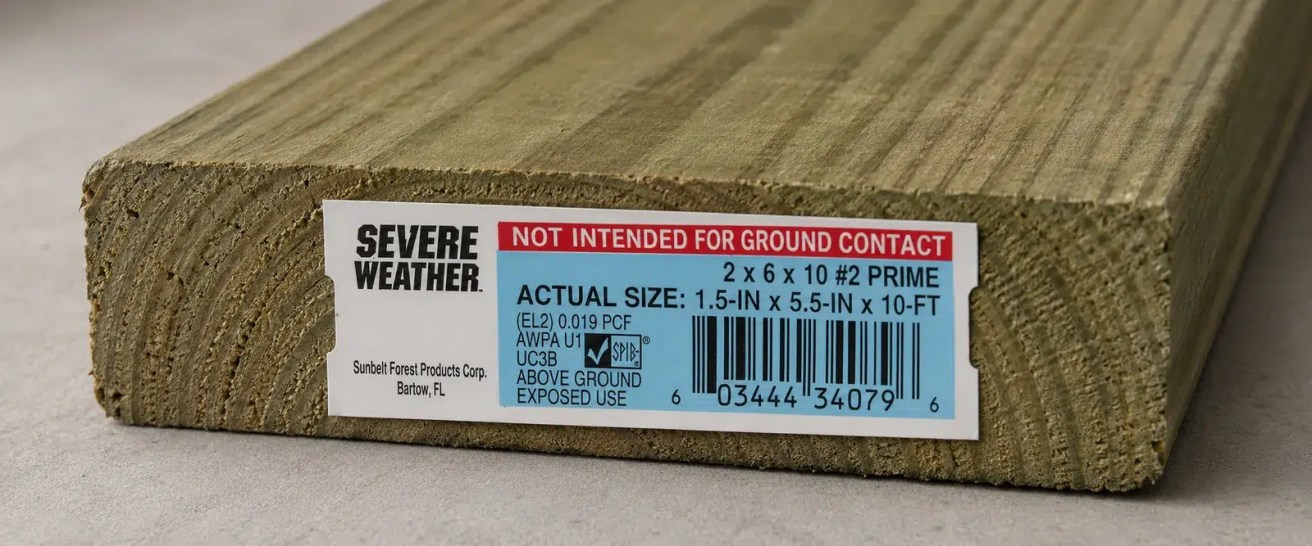
Start with the labels, the only sure thing. New treated lumber has a tag stapled to the end or an ink stamp listing the preservative (letters like ACQ, CA, MCA, or EL2) and often "Ground Contact." Many tags literally say not to burn it.
A treated-lumber end tag: EL2 is the preservative, and this board is rated for above-ground use only.Image credit: Viance
No tag? Look for rows of small slits along the faces, cut to help the preservative soak in.
Color is only a clue. New treated wood is green or brown, but old treated wood turns the same gray as everything else. (Arsenic-treated wood isn't "almost black," as some forums claim: new CCA was light green.) A shine usually means a stain or sealer, which is its own reason not to burn it. Skip the sniff test too; modern treated wood has little or no smell.
If you can't tell where a board came from, don't burn it. That covers most wood from a deck, fence, shed, playset, or picnic table.
Can You Burn Painted or Stained Wood?
No. With old paint, the big worry is lead. Lead paint was banned for homes in 1978, so the EPA's advice is to treat paint from before then as lead-based until a test says otherwise. The Wisconsin Department of Health Services is blunt: burning is never a safe way to get rid of lead paint. That includes old barn boards with flaking paint or whitewash.
Newer paint and stain are less dangerous but still don't belong in a fire. Pigments, finishes, and sealers burn dirty and add their own chemicals to the smoke. If it's coated, it's out.
Can You Burn Plywood, OSB, or Particleboard?
No. These are wood chips, strands, or thin layers held together with glue, and that glue gives off harmful fumes when it burns. That's the difference between a sheet of plywood and a plain 2x4. The EPA's old Burn Wise program put it simply: never burn plywood, particle board, or any wood with glue on or in it.
That Wisconsin family's main fuel was treated plywood. Particleboard and MDF often add a plastic coating, which is worse.
Can You Burn Pallets? Read the Stamp First
Pallets aren't pressure treated, but pallets that cross borders must be treated for bugs and stamped. Per the USDA, the stamp has a little wheat logo, a two-letter country code, a facility number, and a treatment code:
Reading a pallet stampHT = heat treated to kill bugs. No chemical treatment, but the stamp can't tell you what spilled on it or whether any parts are glued or coated. MB = fumigated with methyl bromide, a pesticide. Don't burn it. No stamp = you don't know how it was treated or where it's been. Skip it.
Our rule: only burn a solid-wood pallet you know is clean, dry, and unpainted, and only in an outdoor fire where it's allowed. If you don't know its history, skip it. Always skip painted pallets and blue pallets. Blue pallets belong to a rental company called CHEP, and CHEP is clear they're never sold and shouldn't be thrown away or reused. We ship our own firewood bundles on CHEP pallets because retailers require them. Pull the nails before or after the fire so they don't end up in your yard.
What About Clean Scrap Lumber?
Clean, dry, untreated, unpainted 2x4 offcuts are the one scrap with a clear yes. They burn fast and hot, which makes them great kindling (in a stove, follow the manufacturer's manual). One catch: a "KD" stamp only tells you the wood was kiln dried. It doesn't prove it's untreated, because treated lumber can be stamped KDAT (kiln dried after treatment). Check for a treatment tag and those small slits too.
Pull the nails and screws first, and check whether your town requires a burn permit. For heating a house, you'll want real hardwood. Our guide to the best firewood to burn breaks down every common species.
Heat-Treated vs. Pressure-Treated: What "Treated" Means on Firewood
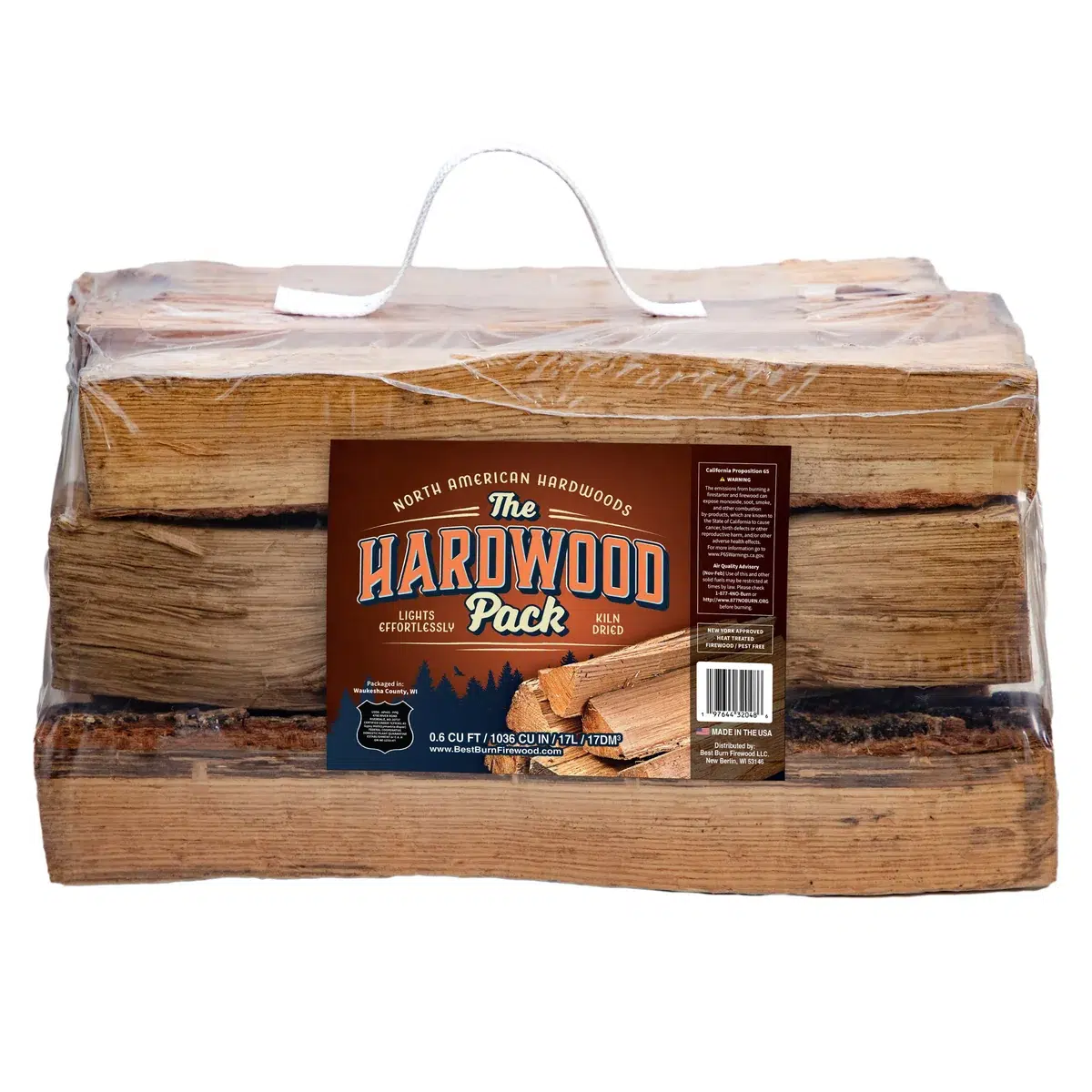
We see this confusion firsthand. The word "treated" on a firewood bundle scares some customers, so we tell them the same thing every time: our firewood is dried in a kiln, and the only thing it's treated with is hot air. Nothing else.
Our kiln-dried Hardwood Pack. "Heat treated" on the label means hot air in a kiln, nothing else.
That's what "heat treated" means on firewood. Our kiln-dried firewood runs through two kilns at a 265°F chamber temperature for 24 to 40 hours, depending on the species, until it's dried to 15% moisture. Our bundles are heat treated to the USDA's T314 standard, which means the center of every piece holds 160°F for at least 75 minutes to kill hidden bugs. We're certified for it under USDA-APHIS compliance agreement SM-WI-1233 and Wisconsin DATCP heat treatment number 2019086. That's the stamp you see on certified heat-treated firewood.
Scrap lumber never ends up in our wood, either. Our logs come straight from Wisconsin loggers and are sorted in the woods, so anything like an old fence post gets thrown out or chipped before a load ever ships.
How to Get Rid of Treated, Painted, and Glued Wood
Reuse comes first: treated boards in good shape are easy to give away, as long as they stay away from gardens, compost, and food.
For the rest, call your local landfill or transfer station. Most take treated lumber, sometimes for a fee. In Wisconsin, the DNR's rules ban open burning of wood that's been painted, treated, laminated, or glued.
Two myths. "It's safer in my stove than a landfill": no. Landfills are built to hold waste; a fire turns the metals into smoke and loose ash where you live. "It's hazardous waste": federal rules don't count lumber from your own deck as hazardous waste, so you usually don't need a special drop-off.
Cutting it? Work outside, wear a dust mask and gloves, and bag the sawdust.
FAQ: Burning Pressure-Treated Wood
Can you burn pressure-treated wood in a fire pit?
No. Being outside doesn't make it safe. You and anyone around the fire breathe the smoke, and the ash, which holds most of the metals, ends up in your yard. Never cook over it.
Why is it illegal to burn treated wood?
Because burning releases the preservatives into the air and concentrates them in the ash. There's no single nationwide law, but many states and towns ban it. Wisconsin, for example, bans open burning of painted, treated, laminated, or glued wood. Check with your local fire department before burning anything other than clean wood.
Can burning treated wood kill you?
It can make people seriously ill. The best-documented case, a Wisconsin family who burned treated plywood in their wood stove for years, involved repeated indoor exposure. Don't take the chance with any amount. If someone has trouble breathing, call 911. For other symptoms, call Poison Control at 1-800-222-1222.
Nothing added but heatFirewood that's only ever been treated with hot air✓ Kiln-dried to 15%, so it lights easily and burns clean✓ USDA heat treated, with no chemicals of any kind✓ Delivered across SE Wisconsin, from a half face cord to a full cordOrder Kiln-Dried FirewoodOutside SE Wisconsin? Find our kiln-dried hardwood bundles at Sam's Club.
Tyler Mainka is co-founder of Best Burn Firewood in New Berlin, Wisconsin, where he works directly in sourcing, processing, kiln-drying, packaging, and delivering firewood for residential and commercial customers. His writing is based on first-hand experience with wood species performance, moisture control, storage, and burn quality, including how different hardwoods behave in fireplaces, wood stoves, and outdoor fires. Tyler publishes practical guides to help customers choose the right firewood and burn it more safely, cleanly, and efficiently.
burning lumberburning wood safetycan you burn palletscan you burn treated woodpressure treated wood