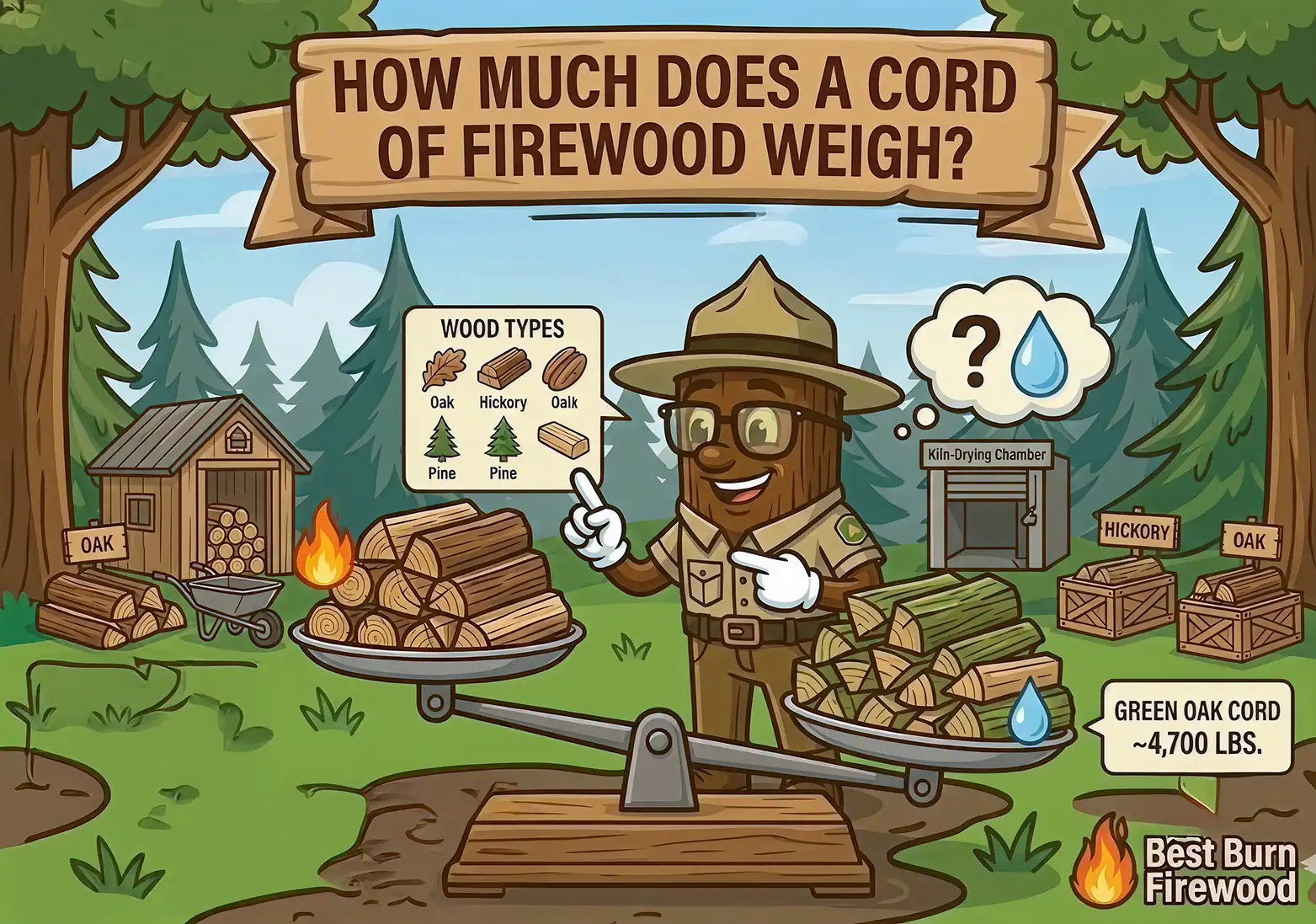
A cord of firewood can weigh anywhere from about 3,000 to over 5,000 pounds, and most of that swing is water, not wood. We weigh every load that comes through our yard, so instead of a vague range, here are the real weights by species, green versus kiln-dried at 15%. You will also get a straight answer on what a full cord does to your truck before you try to haul one.
A cord of firewood weighs roughly 3,000 to 5,200 pounds. That is a wide spread, and the reason it is so wide comes down to two things: what species the wood is, and how much water is still in it. A cord of green oak and a cord of kiln-dried cherry are both legitimately a full cord of firewood, and they can weigh more than a thousand pounds apart.
We weigh wood for a living. Every load that comes into our New Berlin yard gets measured, and our logs arrive on trailers with scales built right in. So instead of the vague "3,000 to 5,000 pounds" you will find on most sites, here are the actual numbers by species, green and kiln-dried, plus what that weight means when you go to haul a cord of wood yourself.
The Short Answer: How Much a Cord of Wood Weighs
A full cord of dry hardwood (seasoned or kiln-dried) weighs about 3,000 to 4,400 pounds. Green, freshly cut hardwood runs heavier, roughly 3,500 to 5,200 pounds, because it is still full of water. Softwoods like pine weigh much less, closer to 2,200 to 3,500 pounds depending on how dry they are.
Quick reference: weight of a full cord of woodDry hardwood (kiln-dried or seasoned): about 3,000 to 4,400 lbs. Green hardwood: about 3,500 to 5,200 lbs. Softwood like pine: about 2,200 to 3,500 lbs.
If that range looks wide, the species is the reason. A cord of dense white oak can outweigh a cord of cherry or pine by well over a thousand pounds, so a single "weight of a cord of wood" figure is really just an average, which is why we break it down species by species further down. The other big lever is moisture, since water is heavy, and it is why a heavier cord is not the same thing as more firewood.
Why Cord Weight Varies So Much (Moisture Is the Biggest Factor)
Water is the single biggest reason two cords of the same species weigh differently. Freshly cut green wood can be close to half water by weight. As it dries, that water leaves and the wood gets lighter, without losing any of the fuel that actually burns.
This is where our kiln numbers come in. We dry our firewood to 15% moisture. That is the sweet spot we have settled on over more than ten years: dry enough to light easily and burn clean and hot, but not so dry that it burns up too fast. Getting a cord of oak from green down to 15% means pulling 800 to 1,000 pounds of water out of every single cord.
One of our kilns in the early heat-up stage on a November evening. That is not hot air, it is true steam venting from the controlled exhaust fans: water leaving the wood.
That number is not an estimate. We run our kiln-dried firewood at 265 degrees Fahrenheit, and most hardwoods take 24 to 32 hours. Oak is the stubborn one. It runs 36 to 40 hours, and in a cold Wisconsin winter it is almost always closer to 40. Ash, which comes in naturally lower in moisture, dries in about 24 hours. The steam pouring off the exhaust in the photo above is exactly that water on its way out.
800 to 1,000 pounds of water per cordAcross nearly every species we run, the kiln removes 800 to 1,000 pounds of water from each cord. That weight is pure water, not fuel. It is the difference between wood that burns clean and wood that hisses, smokes, and wastes its heat boiling off moisture.
Cord Weight by Species (Heaviest to Lightest)
Denser wood weighs more per cord, green and dried alike. Below are real weights from our own scales for the species we process, with pine included as a softwood reference point that just about everyone in the country can picture. Oak and hickory sit at the top. Cherry and pine sit at the bottom.
Species
Green (lbs per cord)
Best Burn Kiln-Dried, 15% (lbs per cord)
Notes
White Oak
~5,200
4,200 to 4,400
Heaviest common firewood, longest burn
Hickory
~5,000
4,000 to 4,200
Dense, top heat output, favorite for smoking
Red Oak
~4,800
~4,000
A few hundred lbs lighter than white oak
Birch
4,200 to 4,500
3,500 to 3,700
Mid-weight, easy to light
Cherry
3,800 to 4,000
3,000 to 3,200
Lighter hardwood, aromatic
Mixed Hardwood (mostly ash)
3,500 to 4,000
3,000 to 3,500
Ash dries fast and burns clean and hot
Pine (softwood reference)
~3,000 to 3,500
~2,200 to 2,500
Much lighter than any hardwood, fast burn
Green weights are approximate and shift with how green the log is, the season it was cut, and whether the tree was already dead. Kiln-dried figures are Best Burn's own measured outputs at our 15% target; other suppliers dry to different levels, so their numbers will differ. Pine is included as a softwood reference and is not a Best Burn product.
A logger's trailer loaded with green logs bound for our yard. Loads like this are weighed by the cord on the scale before they are ever cut and split.
Those green weights are not guesses either. Our loggers haul under special permits at 98,000 pounds gross vehicle weight, well above the standard 80,000-pound semi limit, so they have to watch weight closely to stay legal with the DOT. Their trailers carry scales, and we have a truck scale in our own yard. We see the weight per cord on nearly every load that comes in. White oak is the heaviest wood we handle, running a few hundred pounds a cord more than red oak when green.
Weight and heat output go hand in hand. The densest, heaviest species carry the most fuel per piece, which is why heavy hardwoods like oak and hickory are also among the best firewood to burn for long, hot fires.
Why Two Cords of the Same Wood Can Weigh Different Amounts
Species and moisture explain most of the spread, but even two cords of red oak can come in noticeably different. Three things move it, and we see all three constantly.
Whether the tree was dead when it was cut. A tree that was already dead on the stump has lost much of its water naturally. Dead oak can come in around 4,000 pounds a cord while still technically green, because nature did some of the drying for us. The most common reason we see standing-dead oak is oak wilt, a disease that kills oaks fast. With ash, the culprit is the emerald ash borer, which has wiped out enormous numbers of ash across the Midwest. The larvae feed under the bark and cut off the tree's ability to move water, so it dries out and dies standing. By the time that wood is cut, it already weighs less than a healthy green tree.
When it was cut. Logs cut in winter come in lighter. During the dormant season there is simply less water moving in the tree, and once it is on the ground it does not pull more in unless it is left sitting in water. A lot of wood burners specifically prefer winter-cut logs for this reason. It is not a dramatic difference, but it is real and we notice it load to load.
How long it has been split and stored. Wood that has been split and sitting under cover for months keeps giving up moisture, as ong as it is stored the right way. Fresh-split green wood is at its absolute heaviest. You can check the moisture yourself with an inexpensive meter if you want to know where a given pile actually stands.
Face Cord, Half Cord, and Rick Weights
If you are buying a smaller amount, the math is simple. A face cord (called a "rick" in much of the Midwest and South) is one-third of a full cord, so it weighs roughly a third as much, and a half cord is half the weight. If the terms themselves are what trip you up, our guide on the difference between a face cord, a full cord, and a rick sorts out the sizes. This section is only about what they weigh.
Using our kiln-dried oak as the example, with a full cord around 4,000 to 4,400 pounds: a face cord of kiln-dried oak runs roughly 1,350 to 1,450 pounds, and a half cord lands around 2,000 to 2,200 pounds. Lighter species scale down the same way. A face cord of kiln-dried cherry is closer to 1,000 to 1,100 pounds. All of that weight ends up standing on whatever you stack it on, which is why our guide on how to stack firewood starts with the base.
What Your Vehicle Can Actually Haul
This is where weight stops being trivia and starts mattering. A full cord of green hardwood can run 4,500 to 5,200 pounds. A typical half-ton pickup (an F-150 or Silverado 1500) is rated for somewhere around 1,500 to 2,000 pounds of payload. That means a full cord is two to three times more than your truck is built to carry safely.
Check your payload before you load.Your vehicle's payload rating is printed on the sticker in the driver's door jamb. A full cord will exceed almost every half-ton pickup, and an overloaded truck is hard to stop and rough on the suspension. When in doubt, take less per trip or have it delivered.
Realistically, a half-ton pickup can handle about a half cord of seasoned wood per trip if you load it carefully. A three-quarter-ton or one-ton truck can do more. Past that you are into trailers, and a loaded trailer has its own weight rating to respect.
For comparison, our delivery trucks are built for exactly this. Each one carries up to two full cords (six face cords) per load. We measure firewood loose rather than stacked: 60 cubic feet of loose-thrown wood per face cord, 180 cubic feet for a full cord. Loose firewood takes up roughly 40% more space than neatly stacked wood because of the air gaps, so 180 cubic feet loose settles into the standard 128 cubic feet of a stacked cord. We have tested that conversion many times. It is how we make sure you get a true full cord and not a truck bed that only looks full.
Why Firewood Is Sold by the Cord, Not by the Pound
Here is the part that protects you as a buyer: heavier is not better. Because so much of a green cord's weight is water, a heavier cord often just means wetter wood, which is worse firewood, not more of it. That is exactly why firewood is sold by volume, the cord, and not by weight. If it were priced by the pound, the soggiest, greenest wood would cost the most, which is backwards.
What you actually want is a full 128 cubic feet dried to 15% moisture, so that nearly all of the weight you are paying to haul and burn is fuel instead of water. Get that right and the weight takes care of itself.
We have covered what a cord weighs. If you are curious how a cord is actually measured, and what 128 cubic feet looks like when it lands in your driveway, our guide on how much firewood is in a cord breaks it down.
Frequently Asked Questions
How much does a full cord of firewood weigh?
A full cord of dry hardwood weighs about 3,000 to 4,400 pounds. Green hardwood runs heavier, roughly 3,500 to 5,200 pounds, because of the water still in it. Softwoods like pine are lighter, around 2,200 to 3,500 pounds.
Does green or seasoned firewood weigh more?
Green wood weighs more, often by 800 to 1,000 pounds per cord. That extra weight is water. As the wood dries to 15% moisture, the water leaves and the wood gets lighter without losing any burnable fuel.
How much does a cord of kiln-dried firewood weigh?
For our kiln-dried hardwood, a full cord runs about 3,000 pounds for lighter species like cherry and mixed ash, up to 4,200 to 4,400 pounds for white oak. We dry everything to 15% moisture.
How much does a face cord weigh?
A face cord is one-third of a full cord, so it weighs about a third as much. A face cord of kiln-dried oak is roughly 1,350 to 1,450 pounds. "Rick" is another common name for a face cord.
Can a pickup truck haul a full cord?
Not safely, in most cases. A full cord can weigh 4,500 to 5,200 pounds green, while a half-ton pickup is usually rated for 1,500 to 2,000 pounds of payload. A half-ton can handle about a half cord of seasoned wood per trip. Always check the payload sticker in your door jamb before loading.
Which firewood is the heaviest?
Among common firewoods, white oak and hickory are the heaviest per cord, green and dried. Oak is also the densest fuel, which is why it burns long and hot. Pine and other softwoods are the lightest.
Whether you are heating all winter or just want clean wood for weekend fires, what matters is getting a full cord of properly dried hardwood, not a heavy load of water. We deliver kiln-dried firewood across SE Wisconsin, measured to a true full cord and dried to 15% moisture. Order a cord of kiln-dried firewood or reach out with any questions about quantities and weights.
Tyler Mainka is co-founder of Best Burn Firewood in New Berlin, Wisconsin, where he works directly in sourcing, processing, kiln-drying, packaging, and delivering firewood for residential and commercial customers. His writing is based on first-hand experience with wood species performance, moisture control, storage, and burn quality, including how different hardwoods behave in fireplaces, wood stoves, and outdoor fires. Tyler publishes practical guides to help customers choose the right firewood and burn it more safely, cleanly, and efficiently.
cord of firewood weightcord weightfirewood weightgreen wood weightHow Much Does a Cord of Firewood Weigh?weightwood weight