Is Cherry Good Firewood? Heat, Aroma, and How It Actually Burns
Cherry is good firewood, but not for the reason most people buy it: moderate heat at 20.4 million BTU per cord, a sweet fruit-tree aroma, and more blue in the flame than almost any hardwood we sell. The part nobody writes down is how fast it dries, and our kiln logs put a number on it.
Cherry is good firewood, and most people buy it for the wrong reason. It is not a top-tier primary-heating or overnight wood, and if you are trying to hold a house through a January cold snap, oak or hickory will serve you better. What cherry does better than almost anything else is make a fire worth sitting in front of, and it does one thing nobody talks about: it is ready to burn long before your oak is.
We run kilns and deliver firewood across SE Wisconsin, and cherry moves through our yard every week of the year. Here is what it actually puts out for heat, how long it really takes to dry, and when it is the right wood to reach for.
Is Cherry Good Firewood?
Yes. Cherry is good firewood with moderate, even heat, a sweet fruit-tree aroma, and a clean burn that suits indoor fireplaces better than almost any hardwood we sell. It is not the wood you load the stove with before bed, and it will not match oak or hickory per cord. It is the wood you burn when the fire itself is the point of the evening.
Cherry firewood at a glanceHeat output: 20.4 million BTU per cord (moderate) Burn time: Moderate. Not an overnight wood Seasons in: 6 to 12 months air-dried, considerably faster than oak Good for fireplaces? Yes. Low smoke, easy lighting, and the best-looking flame we sell Aroma: Sweet, mild, distinctly fruit-tree Best use: Indoor fireplaces and fire pits, plus smoking pork and poultry
Cherry Firewood Heat Output (BTU and Cord Weight)
Heat output is measured in BTUs per cord, and cherry lands in the middle of the hardwood range at roughly 20.4 million, or 20 to 21 million depending on the forestry table you read. That is real, usable heat. It is not oak. Here is where cherry sits against the other species we process:
Species
BTU per Cord
Density
Heat Rating
Hickory
27.7 million
Very dense
Premium
Oak (White)
26.4 million
Dense
Premium
Oak (Red)
24.6 million
Dense
Excellent
Maple (Hard)
23.9 million
Dense
Excellent
Ash
23.6 million
Dense
Excellent
Birch (Yellow)
21.8 million
Medium-dense
Good
Cherry
20.4 million
Medium-dense
Good
BTU values are published averages from forestry sources including the USDA Forest Service and university extension programs. Actual output varies with growing conditions, density, and moisture content at the time of burning.
You will occasionally see cherry described as producing heat similar to oak. It does not. The gap is 4 to 9 million BTU per cord depending on which oak you compare against, and you will feel it in a cold room.
Weight tells the same story. Our Wisconsin black cherry runs about 3,800 to 4,000 pounds per cord green, and 3,000 to 3,200 pounds per cord of firewood once it leaves our kilns at 15% moisture. White oak lands around 4,200 to 4,400 pounds dried. Less dry wood mass per cord is the main reason cherry produces fewer BTUs per cord than denser woods such as oak.
How Long Cherry Firewood Takes to Season
Properly split and stored cherry firewood commonly reaches burnable moisture in 6 to 12 months, considerably sooner than oak. This is the single most misunderstood thing about cherry, and it is the reason it deserves a place in a woodpile even if you heat primarily with something denser.
You will find guidance online putting cherry at 12 to 24 months. That is oak's timeline applied to the wrong species. Oak is one of the wettest hardwoods when cut and one of the slowest to give that water up. Our kiln records and yard experience consistently show properly split black cherry reaching the target moisture considerably sooner than oak.
Cherry split and properly stacked in March can often be ready by late fall. Not as good as kiln-dried, but it will burn. Oak from the same season may miss that first winter entirely and commonly needs 12 to 24 months.
Conditions matter as much as the calendar. Air, sun, and getting the wood up off the ground do the work, so that 6 to 12 month window assumes you are storing the wood properly. A stack in a shaded, damp corner behind a shed will not hit 6 months no matter the species. For timelines by species and split size, see our guide on how long firewood takes to season.
Do not judge readiness by the calendar. Split a piece and test the fresh face with a moisture meter, not the weathered outside, which reads misleadingly low. Air-dried firewood should be under 20% before you burn it, which lines up with EPA moisture meter guidance.
What our kilns show: cherry vs oakCherry: 24 to 26 hours at 265°F. Up to 26 to 30 hours if the logs were fresh cut and very green, which is the most cherry ever requires. Oak: 36 to 42 hours at 265°F, running at the long end in a Wisconsin winter. Ash: Usually our shortest runs, but that is about supply more than species. Most Wisconsin ash is emerald ash borer affected and arrives partway dry.
These are Best Burn production figures for Wisconsin black cherry cut into 16-inch splits, processed in our own 265°F kilns and dried to 15% moisture. Times vary with how green the logs were when they arrived.
Same kilns, same temperature, same target moisture. Cherry needs a little over half the chamber time oak does. That is not an opinion about drying speed, it is what the controller logs. If you want the fuller explanation of what seasoned firewood actually means and how it differs from kiln-dried firewood, we cover both separately.
That 6 to 12 Months Assumes You Split It
This is where most people lose a season, and cherry is the species it happens to most. Water leaves a log through the cut ends, not through the sides, because bark seals the outside. A whole round has two small exits. Split that same round and you open the entire length of the face. Splitting is not something you do after the wood dries, it is what starts the wood drying.
Cherry makes this trap worse than most species. Cherry bark stays on well. It does not shed or break apart the way oak bark does as it dries, so a cherry log holds its seal longer. Split cherry is one of the faster woods in the yard. Cherry left in the round is one of the slower ones. Same tree, opposite answer, decided entirely by whether a splitter touched it.
We have cherry sitting on our lot right now that came off the landing 12 to 18 months ago. The ends are grey, the bark is checked, and it looks every bit like seasoned wood. Run it through the processor and test a fresh face and it reads high 20s to low 30s. Eighteen months of weather bought that log almost nothing, because almost none of it was ever exposed.
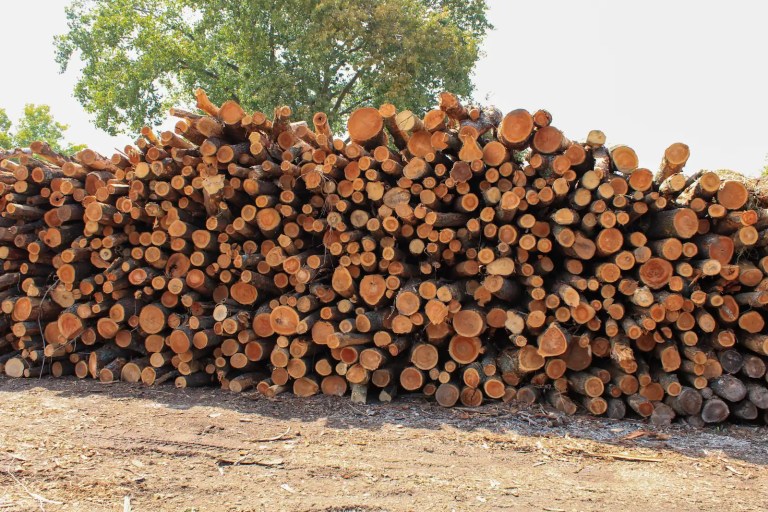
Fresh cut. Cherry delivered to our yard the same day it came off the landing. The end grain is still bright orange-pink and the bark is tight.
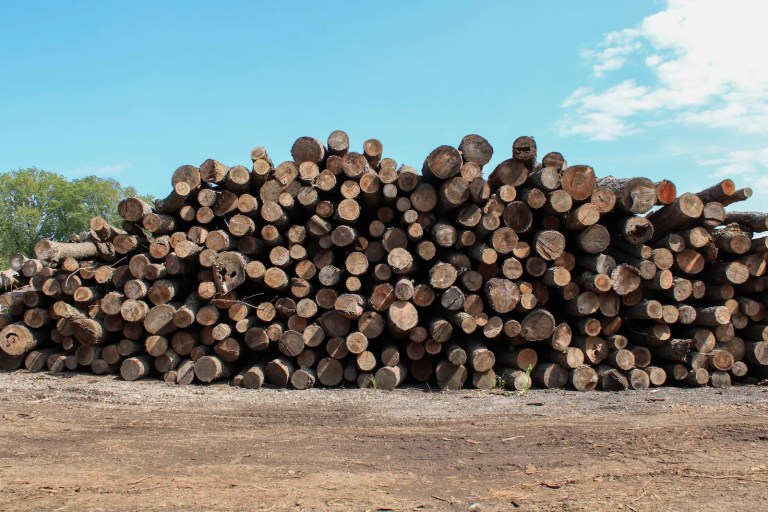
Down 12 to 18 months. Grey checked ends, weathered bark, and it looks seasoned. Split one in the processor and test the fresh face: high 20s to low 30s. Eighteen months of weather bought these logs almost nothing.
What Counts as Cherry Firewood (and What Your Tree Is Worth First)
In our Wisconsin operation, cherry firewood means black cherry, Prunus serotina, also commonly called wild cherry. Same tree, two names, which is worth knowing if you have been told you have wild cherry on your property and were not sure whether it was worth cutting. It is.
Other trees sold or described as cherry may be different Prunus species. Sweet cherry, sour cherry, chokecherry, and old orchard trees all burn, and orchard wood is a well-regarded smoking wood. They just will not have exactly the same density or burn characteristics as the black cherry these numbers come from.
Our cherry comes from Wisconsin loggers working DNR select cuts, land clearing projects, and logs that came in too small for the mills. Most loggers would let cherry ride along in a mixed hardwood load, because sorting it costs money. We pay extra to have it pulled out and kept separate, which is the only reason we can sell cherry as cherry with no filler wood in the cord.
One thing before you fire up the saw: a large, straight, clear cherry trunk may be worth more standing than split. Black cherry is furniture-grade lumber, prized for cabinetry and veneer, and a good log is worth real money to a sawmill. Crooked stems and branch wood are your firewood. Make that call before you buck it into stove lengths, because you cannot undo the cut.
How Cherry Burns: Blue Flame, Crackle, Coals, and Smoke
This is the part that keeps people coming back for cherry, and it is the part every other firewood article skips.
The blue flame. Cherry often shows more visible blue around its flames than many common firewoods. Blue light in a fire comes from burning gases above the wood rather than the wood itself, and cherry's particular mixture of volatile compounds and minerals may make that color more noticeable, especially with good airflow and little yellow soot. You have seen the color before: it is the same blue at the base of a flame or on a lighter. In an open fireplace with good draw, cherry shows it clearly. Even in a closed stove, where you normally get a solid orange glow, cherry throws more of a blue cast.
The crackle. Cherry has a noticeably more distinctive crackle and pop than oak, and most people count that as a feature. Worth being precise here, because most firewood guides blur two different things together: crackling is the sound, ember throwing is the safety concern. Cherry crackles audibly more than oak but is not a spitter the way pine or cedar is. Use a screen on an open hearth, same as any fruitwood, and you are fine.
Coals. Better than the BTU number suggests. Cherry builds a workable coal bed that holds heat after the flames drop and outlasts a lighter wood like soft maple. It will not match oak or hickory overnight, but it does not quit the moment the flames die either.
Smoke. Low, when the wood is properly dry, which is exactly why cherry works indoors. At 15% moisture, it lights readily with proper kindling and settles into a clean fire.
Ash. Moderate. In our experience cherry leaves a little more firebox residue than longer-burning woods like oak or hickory, whose sustained coal beds give more of the remaining wood time to burn down. It is not an unusually ashy firewood, and it is not something customers complain about.
When Cherry Is the Right Firewood
After enough years of taking orders, the pattern is clear, and it splits the year in half.
Summer belongs to the cooks. Homeowner demand drops off almost entirely once the weather turns warm, and that is the right call. Cherry costs more than mixed hardwood, and burning a premium wood outdoors where it will not last as long or throw as much heat as oak is a waste of money. Summer volume goes to smoking: backyard cooks, catering companies, and the portable smoker trucks that run events all season.
Fall and winter belong to homeowners. Once the temperature drops, cherry becomes one of our busiest single-species orders. People buy it for the smell, the blue flame, and the way the wood looks stacked in a rack next to a fireplace. It looks expensive because it is, and there is nothing wrong with that being part of the appeal. The moderate heat is a feature here too: a fireplace loaded with cherry warms a room without driving everyone out of it, which is a real complaint we hear about hotter woods in small spaces.
Mixing. For anyone burning regularly: cherry to light and build the fire, then oak or hickory on top to hold it. Cherry catches fast and burns clean, which makes it a better starter than a dense split that fights you for twenty minutes.
When cherry is the wrong call. Sub-zero nights when you need maximum output. Primary wood heat with a stove running daily. Tight storage where you have room for one species and it needs to be the one doing the most work. In all three cases, buy oak.
Cooking and Smoking with Cherry
Cherry is best known for pork and poultry. The smoke is mild and slightly sweet, and it lays down a deep mahogany color that is most of the reason cooks reach for it.
Here is a distinction most people never encounter. Smoke Shack in Milwaukee, one of the wood-fired restaurants we supply, buys green cherry from us on purpose for its baby back ribs. Green wood produces more smoke, and in controlled commercial smoking equipment that is exactly what they want. Homeowners buy the opposite: kiln-dried cherry at 15% for a clean, low-smoke burn. Same species, opposite specification, opposite reasons.
That is a commercial practice in purpose-built equipment, not a recommendation for your fireplace. For home burning, dry wood is always the answer. For pairings by protein and dish, see our cooking wood guide with protein pairing chart.
How Cherry Compares to Other Firewood Species
Cherry
Oak
Hickory
Birch
Ash
BTU per cord
20.4M
24.6 to 26.4M
27.7M
21.8M
23.6M
Burn time
Moderate
Very long
Very long
Moderate
Long
Ease of lighting
Easy
Harder
Harder
Easy
Easy
Aroma
Sweet, fruity
Mild, earthy
Strong, smoky
Mild, pleasant
Mild
Air-dry time
6 to 12 months
12 to 24 months
12 to 18 months
6 to 9 months
6 to 12 months
Best for
Fireplaces, ambiance, smoking
Overnight heat, primary heating
Max heat, bold smoke
Quick fires, kindling
All-purpose
The short version: cherry is the wood you burn for the experience. Birch is its closest cousin here, another moderate-heat species that lights fast and dries quickly, and neither one carries a Wisconsin winter alone. For all 14 species with BTU data, burn ratings, and use cases, see our complete firewood species guide.
FAQ: Cherry Firewood
What burns better, oak or cherry?
For heat and burn time, oak. It produces 24.6 to 26.4 million BTU per cord against cherry's 20.4 million, and it holds coals far longer. For easy lighting, clean burning, and aroma, cherry wins. Most people who burn regularly keep both and use each for what it does well.
How long does cherry firewood need to season?
Properly split and stored cherry commonly reaches burnable moisture in 6 to 12 months, considerably sooner than oak's 12 to 24 months. In our experience, properly split and stored black cherry dries considerably faster than oak. Always test a freshly split face and look for moisture below 20%.
What are the disadvantages of cherry wood?
Moderate heat is the main one. At 20.4 million BTU per cord, cherry will not hold a fire overnight the way oak or hickory will. It crackles more than oak, so an open fireplace wants a screen. It produces a moderate amount of ash and, in our experience, leaves slightly more firebox residue than longer-burning woods such as oak or hickory. It also costs more than mixed hardwood.
Is it safe to burn cherry wood?
Yes. Cherry is safe to burn in fireplaces, wood stoves, and outdoor fire pits, and it is one of the most popular woods for smoking pork and poultry. Kiln-dried cherry has been heat-treated, which kills insects and mold, so it is safe to stack indoors when kept dry. As with any species, never burn wood that has been painted, stained, glued, or pressure-treated.
Does cherry firewood burn hot?
Cherry burns at moderate heat, not high heat. Roughly 20.4 million BTU per cord puts it in the middle of the hardwood range alongside birch. That is an advantage indoors, where a hotter wood can make a small room uncomfortable, and a disadvantage if wood is your primary heat source.
Why does cherry firewood crackle and pop?
Crackling comes from pockets of moisture and gas expanding inside the wood and releasing suddenly. Cherry has a distinctive crackle, more than oak, and most people consider it part of the appeal. That is different from throwing embers: cherry is not a spitter the way pine or cedar is.
Is cherry good for smoking meat?
Yes. Cherry is one of the most popular smoking woods for pork and poultry, delivering mild, slightly sweet smoke and a deep mahogany color on the finished meat. It pairs well with stronger woods like hickory or oak when you want more depth. See our cooking wood guide for pairings by protein and dish.
We sell kiln-dried cherry firewood by the cord, half cord, and face cord, dried to 15% and WDATCP certified. Delivered across SE Wisconsin and ready to burn the day it arrives.
Tyler Mainka is co-founder of Best Burn Firewood in New Berlin, Wisconsin, where he works directly in sourcing, processing, kiln-drying, packaging, and delivering firewood for residential and commercial customers. His writing is based on first-hand experience with wood species performance, moisture control, storage, and burn quality, including how different hardwoods behave in fireplaces, wood stoves, and outdoor fires. Tyler publishes practical guides to help customers choose the right firewood and burn it more safely, cleanly, and efficiently.
black cherryburning cherry firewoodcherry blue flamecherry firewoodcherry woodcooking and smoking with cherry woodis cherry good firewood