What Is Seasoned Firewood? A Straight Answer From People Who Dry Wood for a Living
Seasoned firewood is wood that has been cut, split, and dried until it is light enough to burn clean, usually 20% moisture or less. But "seasoned" is not a promise, and plenty of wood sold that way is still wet in the middle. Here is how to tell the difference, with real moisture readings from our wood yard.
"Seasoned" might be the most misused word in the firewood business. It gets stamped on ads, stacked on pallets, and promised over the phone, and half the time the wood behind it is still soaking wet in the middle. We know because we run kilns, and every week we test wood that someone, somewhere, called seasoned.
This guide gives you the straight version. What seasoned firewood actually is, how to tell if it is really dry, what it looks like, and why the word alone is not a promise you can trust. No sales pitch, no scare tactics. Just what we see at the yard.
What Does "Seasoned" Firewood Actually Mean?
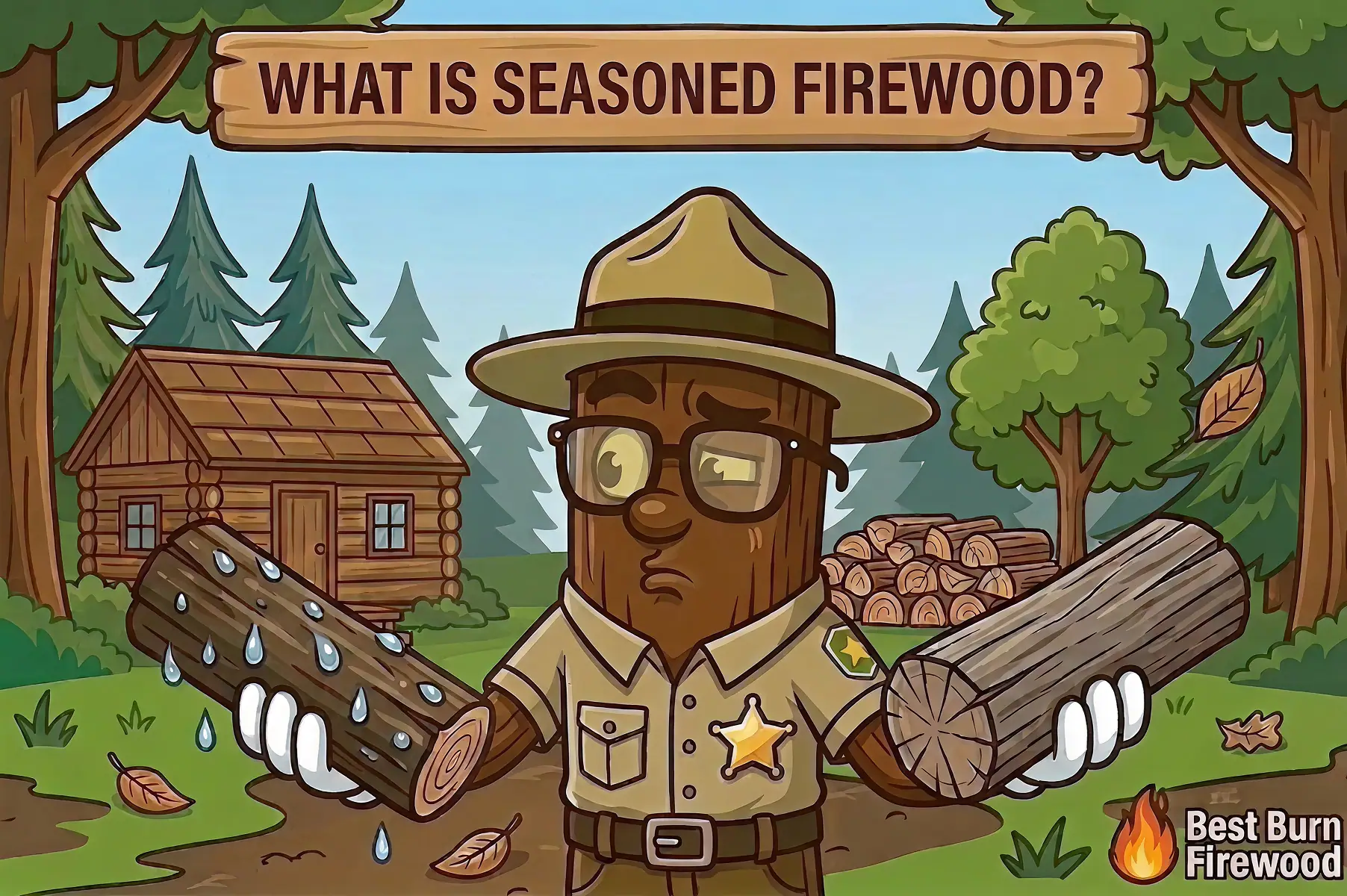
Seasoned firewood is wood that has been cut, split, and left out to dry so the water inside it can escape. Fresh-cut wood is heavy with moisture. A living tree is roughly half water by weight. Seasoning is simply the drying process that lets that water evaporate over time until the wood is light enough and dry enough to burn well.
Here is the part most people miss: seasoning is a process, not a guarantee. Calling wood "seasoned" only tells you it was set out to dry. It does not tell you for how long, in what conditions, or whether it actually reached a moisture level low enough to burn clean. Properly seasoned firewood should sit around 20% moisture or less. Plenty of wood sold as seasoned never gets close.
The short versionGreen wood starts near 50% moisture. Seasoned wood has dried down toward 20% or less. "Seasoned" describes the drying process, not proof that the wood is actually dry.
How Wet Is Fresh-Split Wood, Really?
Wetter than almost anyone expects. When you split a fresh log, the inside is packed with water that has no easy way out yet. On dense wood like oak, that fresh face can read close to 50% moisture. Half the weight in your hands is water.
We tested some fresh-split red oak and ash at the yard. The photos below are the actual meter readings, straight off the split face.
Fresh-split red oak. Notice how pale and bright the wood is. That center has never seen sun or air.The same fresh oak, tested right on the split face: 47%. That is nearly half water by weight.
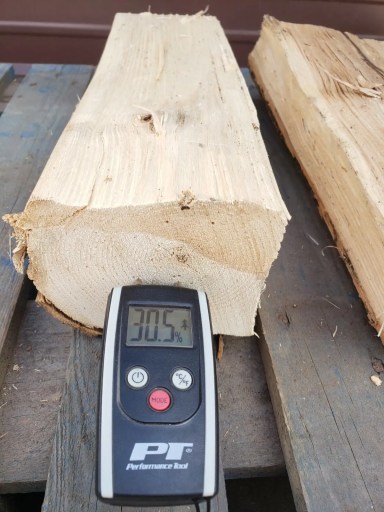
Ash is lighter and less dense than oak, so it dries faster and starts a little lower. Still wet, though.
Fresh-split ash. Lighter than oak, but still wet through the middle.Fresh ash on the meter: 30.5%. Wetter than most people would ever guess by looking.
Why Real Oak Takes So Long to Season
This is where a lot of "seasoned" claims fall apart. Oak is one of the best woods you can burn, but it is also one of the slowest to dry. It is dense and it holds its water stubbornly. Air-drying oak the right way takes a solid 18 months, and that is only if the conditions are right the whole time.
By "the right conditions" we mean all of these, not just one:
What oak needs to actually seasonOff the ground: up on pallets or racks, not sitting in the mud soaking moisture back up. Airflow: stacked loose enough for wind to move through it. Split: whole rounds barely dry, splitting opens the wood up. Sheltered from rain: top-covered so rain and snow are not re-wetting it. Sun and heat: a warm, sunny spot speeds everything up.
Miss any of those and the clock basically stops. Oak left in a shady pile on wet ground can sit for two years and still be wet inside. So when someone sells you "seasoned oak" that was split a few months ago, the math simply does not work. Real oak needs the time.
A couple of notes from experience. This was red oak in our tests. White oak is even denser and harder to dry, so it needs every bit of that time and then some. Maple is roughly on par with oak for drying speed. Ash and lighter species come around faster, which is one reason ash has a reputation as a burn-it-sooner firewood. For how the common species stack up, see our firewood species and burn guide, for the deeper timeline on drying, our guide on how long firewood takes to season, and for keeping wood dry once it is split, our guide on how to store firewood. And if the stack itself is the question, our guide on how to stack firewood covers the patterns that stay up and let the wind through.
What Seasoned Firewood Looks Like (and Why Color Fools People)
Color is the first thing people judge, and it is also where they get tricked. Here is the simple way to think about it.
Fresh-split wood is pale and bright, almost creamy. That makes sense once you picture it: the inside of a log has never seen the sun or the open air, so it has not changed color at all. Bright and pale usually means freshly cut.
Now leave that wood outside to season for a year or more. The sun and weather go to work on the exposed faces and slowly turn them grey, the same way an old fence board or a deck ages to grey over time. So properly air-seasoned firewood often looks weathered and dull grey on the ends and faces.
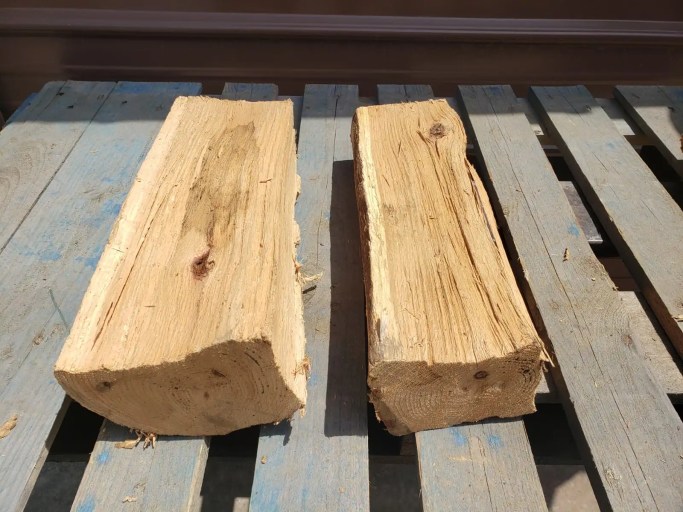
Kiln-dried wood is a different look again. The heat inside the kiln gently toasts the wood, the way a toaster browns bread, and pulls the color toward a warm tan or honey. Same wood, different path, different color.
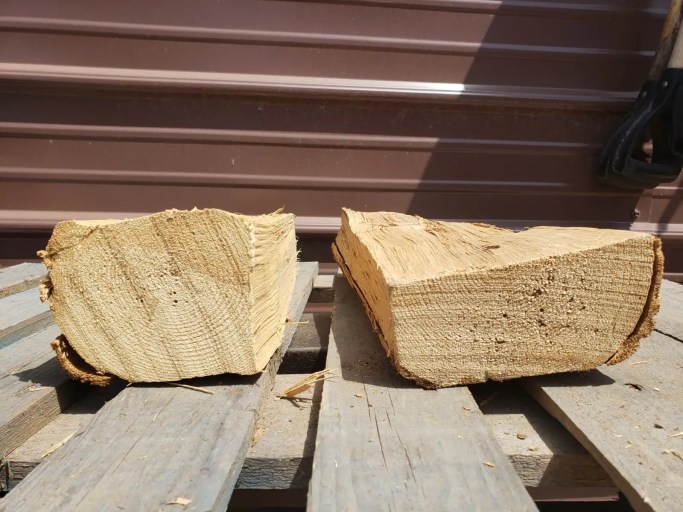
The same oak after the kiln. Warmer tan color from the heat, and a little smaller, because the water weight has cooked off.
Notice the size, too. Wood shrinks a bit as it dries, because you are literally removing water and mass from the log. A dried piece is lighter and slightly smaller than it was green.
But here is the honest part, and it is the whole point of this section: color and cracks tell you the wood is not fresh. They do not prove the inside is dry. A grey, checked-looking piece can still be wet in the core. We have cherry logs on our lot that have been down 12 to 18 months, look fully weathered, and still read high 20s to low 30s when we split one open. The only way to actually know is to measure it.
How to Tell If Firewood Is Actually Seasoned
Use the visual signs as a first glance, then verify. Here are the signs people rely on, with the honest truth about each one.
The signs, and what they really tell youCracks and splits on the ends: a good hint, but wood can crack on the surface while still holding water deeper in. Grey, weathered color: means the wood is not fresh, not that it is dry all the way through. Loose or peeling bark: another decent hint, easy to fake by picking older-looking pieces. Light weight: dry wood is noticeably lighter, but hard to judge without something to compare to. The knock test: two dry pieces make a sharp "clunk," wet ones make a dull thud. Useful, not proof.
Every one of those can be true on a piece that is still wet inside. That is why none of them is a substitute for the one test that actually settles it.
Split a piece open and put a moisture meter on the fresh inside face, not the weathered outside. The outside of any piece dries first, so an outside reading always looks better than the wood really is. The fresh interior is the honest number. Dry, ready-to-burn firewood reads at or below 20% on that fresh face. For the full how-to, see our guide on using a moisture meter on firewood.
Seasoned vs. Kiln-Dried Firewood: What Is the Difference?
Both end at the same goal, dry wood that burns clean. They just take different roads to get there.
Seasoned (air-dried) wood dries slowly outdoors over many months, using nothing but sun and wind. When it is done right, it works great. The catch is that "done right" depends on weather, storage, and time, so the results vary piece to piece and seller to seller.
Kiln-dried firewood skips the waiting. The wood goes into a heated kiln that drives the moisture out in days instead of months, and every load comes out to the same low, measured moisture level. The heat also kills any bugs and mold living in the wood. The tradeoff is that kiln-dried costs more, because of the real equipment and energy behind it.
Green / Fresh-Cut
Seasoned (air-dried)
Kiln-Dried
Moisture
~45 to 50%
~20% or less, if done right
Dried down to 15%
Time to ready
Not usable
6 to 18+ months (oak longer)
A day or two in the kiln
Consistency
n/a
Varies with weather and storage
Same every load, measured
Bugs and mold
Alive in the wood
Possible if stored damp
Killed by kiln heat
Ready to burn?
No
Yes, if you verify it
Yes, on delivery
Moisture percentages and drying times are typical ranges. Actual results vary by species, split size, storage, and climate.
How We Take the Guesswork Out
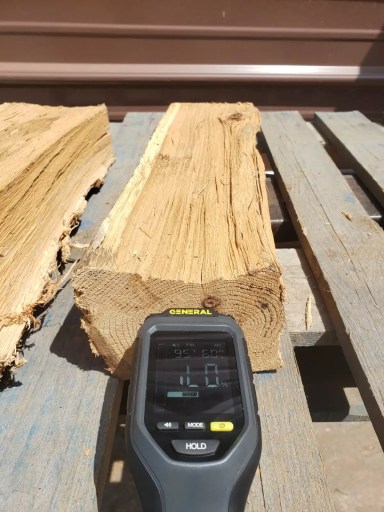
This is where the meter photos get interesting. After our oak and ash went through the kiln, we tested them again. The outer face reads very low, sometimes so low the meter just shows "LO," because the outside dries first and hardest.
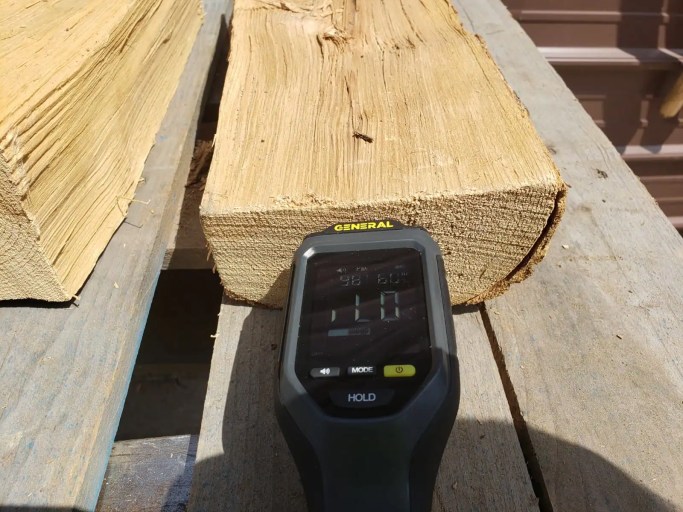
Kiln-dried oak, tested on the outer face: around 5%. The outside always dries first, so this is not the number that matters.Another kiln-dried piece reading "LO" on the surface. The honest test is the core, so we cut pieces open to check it.
The surface number is not the honest one, and we would rather show you the real one. When we cut these kiln-dried pieces open and measured deep in the core, the interior came in at 14 to 16%. That is the number that matters, and it is right on our 15% target. That is what a piece looks like when it is truly dry all the way through, not just on the outside.
Kiln-dried ash, with that same toasted tan color from the heat.Kiln-dried ash on the meter. Cut one of these open and the core measured in the same 14 to 16% range.
Best Burn Firewood kiln265°F, 24 to 32 hours per load for most hardwoods, and up to 36 to 42 hours for dense oak. Every load dries down to a 15% core. USDA and WDATCP certified, Heat Treatment number 2019086.
Why "Seasoned" on a Label Doesn't Always Mean Ready to Burn
Here is the thing to walk away with. "Seasoned" is not a regulated term. Nobody is checking it. There is no inspector making sure a seller who says "seasoned" actually dried the wood to a level you can burn. In some places the word is so loosely defined that wood sitting near 50% moisture can still be called seasoned. That is green wood with a nicer name.
We see the fallout at the yard all the time. People bring us wood they bought as "seasoned" that reads 30% or more on a fresh split, wondering why it hisses, smokes, and will not throw heat. The wood was labeled right and dried wrong.
So protect yourself. Do not buy the word, buy the number. Ask what the moisture content is. Ask when it was split. And if it matters to you, split a piece and check the fresh face with a meter. Dry wood earns the name. The label alone does not.
FAQ: Seasoned Firewood
What is seasoned firewood?
Seasoned firewood is wood that has been cut, split, and left to dry outdoors so its moisture can evaporate over time. Fresh wood is roughly half water by weight. Seasoning brings that down toward 20% or less, the point where wood burns cleanly and efficiently. The word describes the drying process, not a guarantee that the wood is fully dry.
What does seasoned firewood mean?
It means the wood has been dried, usually by sitting outdoors for months, to lower its internal moisture. Well-seasoned firewood sits around 20% moisture or below. Because "seasoned" is not a regulated term, it is worth verifying with a moisture meter rather than trusting the label alone.
How can you tell if firewood is seasoned?
Look for cracked ends, a greyed weathered color, loose bark, and light weight, and listen for a sharp knock rather than a dull thud. Those are hints, not proof. The only sure test is to split a piece and press a moisture meter to the fresh inside face. At or below 20% on that fresh face means it is ready to burn.
What is the difference between seasoned and dry firewood?
"Dry" describes the result, wood low enough in moisture to burn well. "Seasoned" describes the process used to get there, air-drying over time. The catch is that wood can be seasoned (set out to dry) without actually being dry yet, especially dense species like oak that need well over a year. Dry is the goal. Seasoned is one way to reach it.
How long does it take to season firewood?
Most split hardwoods need 6 to 12 months of real drying weather, and oak needs 18 or more. The rest comes down to species, split size and storage, which we cover in our guide to how long each species really needs.
What does seasoned firewood look like?
Air-seasoned firewood tends to look greyed and weathered on the ends and faces, with cracks radiating from the center and bark that loosens or falls off. Fresh-cut wood, by contrast, is pale and bright inside because the core has never been exposed. Kiln-dried wood looks tan or honey-colored from the heat. Color tells you the wood is not fresh, but only a meter proves it is dry.
What is the difference between seasoned and kiln-dried firewood?
Seasoned firewood dries slowly outdoors over months using sun and wind, and its dryness varies with weather and storage. Kiln-dried firewood is dried in a heated kiln in a day or two to a consistent, measured low moisture, and the heat also kills bugs and mold. Kiln-dried costs more but delivers the same result every time.
What happens if you don't season firewood?
Unseasoned wood is full of water, so a lot of the fire's energy goes into boiling that water off instead of heating your home. The result is hard lighting, hissing, heavy smoke, weak heat, and faster creosote buildup in your chimney, which is a real safety concern. Burning wet wood is the most common reason a fire disappoints.
What moisture content is seasoned firewood?
Properly seasoned firewood sits at about 20% moisture or below, measured on a fresh split face. Fresh-cut wood starts near 45 to 50%. Our kiln-dried firewood dries down to a 15% core, verified by cutting pieces open and measuring the center, not just the surface.
Want firewood that is dry all the way through, not just labeled that way? See current pricing and delivery across SE Wisconsin.
Tyler Mainka is co-founder of Best Burn Firewood in New Berlin, Wisconsin, where he works directly in sourcing, processing, kiln-drying, packaging, and delivering firewood for residential and commercial customers. His writing is based on first-hand experience with wood species performance, moisture control, storage, and burn quality, including how different hardwoods behave in fireplaces, wood stoves, and outdoor fires. Tyler publishes practical guides to help customers choose the right firewood and burn it more safely, cleanly, and efficiently.
dry woodseasoned firewoodseasoned woodwet vs dry woodwet woodwhat is seasoned wood