How to Stack Firewood: Patterns That Stay Dry and Never Topple
The best way to stack firewood is in single rows on a solid base, off the ground, cut ends open to the wind, and no taller than 4 to 5 feet free-standing. Our crew stacked 407 customer orders last year, and this guide covers the exact patterns we use, plus the internet's favorite stacking method that we would never build.
Every neighborhood has one: the firewood stack that leaned a little more each week until one morning it was just firewood on the ground. We hear about them every spring. A stack that falls is not bad luck. It is almost always one of a handful of preventable mistakes, and the fixes are simple once you know what actually keeps a stack standing.
We run kilns and deliver firewood across SE Wisconsin, and our crew stacks wood for customers week in and week out. This guide covers how we do it: the patterns that work, the ones that do not, and the honest answer on a few stacking myths that get repeated everywhere.
The short answerThe best way to stack firewood is in single rows on a solid, level base, off the ground, with the cut ends open to the wind. Keep a free-standing stack to 4 or 5 feet, and brace open ends with criss-cross pillars or a rack. Everything else is detail.
What a Good Firewood Stack Actually Does
A stack has three jobs. It stays standing, it lets air move through the wood, and it keeps your firewood where you can actually reach it in January. Any pattern that does all three is a good stack. Any pattern that trades one away for looks is a compromise, and we will get to the most famous compromise further down.
One piece of vocabulary worth getting right, because it changes how you think about the job: a pile is loose wood on the ground, the way it lands when a delivery gets dumped. A stack is wood placed deliberately, piece by piece. A pile traps moisture and hides what is rotting at the bottom. A stack breathes. Turning the first into the second is the whole point of this guide.
Where you put the stack, how you cover it, and whether it belongs in a garage are storage questions, and they get full treatment in our guide on how to store firewood. The one-sentence version: off the ground, top covered, sides open. This article is about the stacking itself.
A stack doing all three jobs | Solid base, straight rows, air moving through, wood within reach.
Start With the Base (and Never Bare Grass)
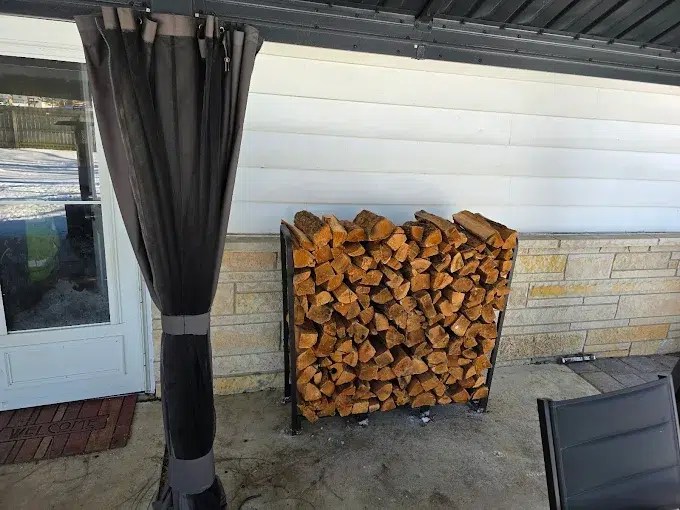
Most stack failures we see start at the bottom, before the first piece of wood goes on. The stack needs something solid and level under it: a firewood rack, a homemade rack built from 2x4s and a bracket kit, a couple of pressure-treated rails, a concrete pad, or a garage wall behind it. A proper firewood rack solves the base, the ends, and the ground clearance in one piece of equipment, which is why most of our customers use one.
What the base can never be is bare grass or soft ground. Wood is heavy. A face cord runs roughly 1,000 to 1,500 pounds depending on the species and how dry the wood is (the full breakdown is in our guide on how much a cord of firewood weighs), and all of that weight presses the bottom layer, or the narrow legs of a rack, straight into the soil. It holds fine in a dry week. Then a wet stretch in spring softens the ground, one edge sinks a half inch deeper than the other, and the whole stack starts leaning. We have taken calls from customers convinced their rack was stacked wrong when the real problem was that the rack was standing on grass and one leg dug in after rain.
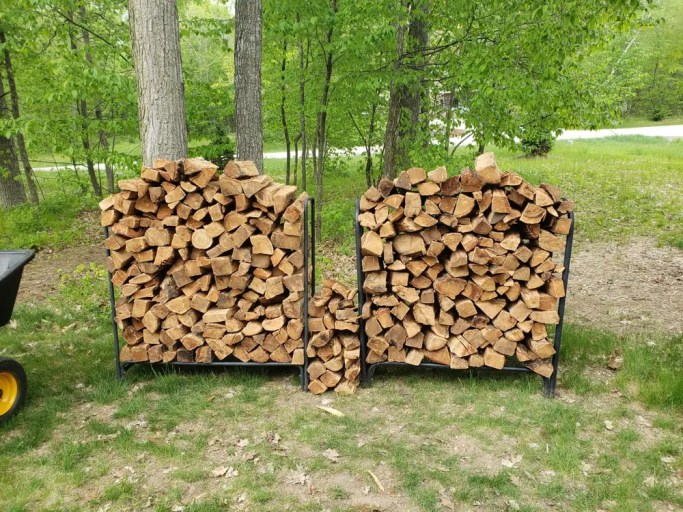
What to watch for | Two racks our crew stacked on grass at a customer's request. We flagged it that day: a loaded rack puts all its weight on four narrow legs, and soft ground lets a leg sink and tip the stack.
The grass ruleIf the surface gives when you press a boot heel into it after rain, it will give under a thousand pounds of firewood eventually. Put something rigid between the wood and the ground: a rack, rails, pavers, or pallets.
Pallets are free, they work, and they come with enough catches that we are giving them their own guide soon. Short version: use them, keep them level, and expect to replace them every few years.
The Row Stack: How a Crew Stacks Wood
The single row is the default for a reason. It is the fastest pattern to build, the most stable per minute of effort, and it gives every piece two open faces to the air. Here is the process our crew uses on customer stacks:
1. Set the base and pick the line. Rack, rails, or wall. If the stack is free-standing, plan the ends first (next section).
2. Work out of a wheelbarrow, not off the ground. Use a two-wheel wheelbarrow if you have one: you push it instead of balancing it, and it does not tip when a wheel catches. Load the wood into the barrow in a stacked, uniform layout rather than tossing it in, and you will fit a surprising amount. Then stack directly out of the barrow at the wall. The barrow sits higher than the ground, so every piece you place is one less deep bend.
3. Place, don't toss. Each piece lies flat on the layer below, roughly parallel to its neighbors, with small gaps left where they naturally occur. Do not pack it tight and do not build it like a puzzle. Snug rows with air in them beat dense rows without.
4. Keep the top level as you go. Mix wide and narrow pieces within each layer instead of saving all the odd ones for the top. A level layer every course is what keeps the fifth layer from wobbling.
5. Bend with your knees. Not a stacking tip, a next-morning tip. A full cord stacked with a rounded back is a mistake you only make once.
For pace, here is what the job actually takes. One crew member stacks a face cord in about 20 minutes on a typical driveway job, a half cord in 30 to 35 minutes, and a full cord in 75 to 90 minutes. The full cord takes disproportionately longer because the pile keeps getting farther from the stack as you work it down, and there is more cleanup at the end. Treat those times as what full-speed looks like, not what to expect: they come from guys who stack wood for a paycheck and do it every week. Homeowners regularly tell us the same quantities took them hours, and that is normal, not slow. It is physical work, and there is no official time. Those numbers come from real jobs. We stack customer deliveries on request, and the crew ran 407 stack jobs in 2025 alone, so the figures in this guide are measured, not guessed.
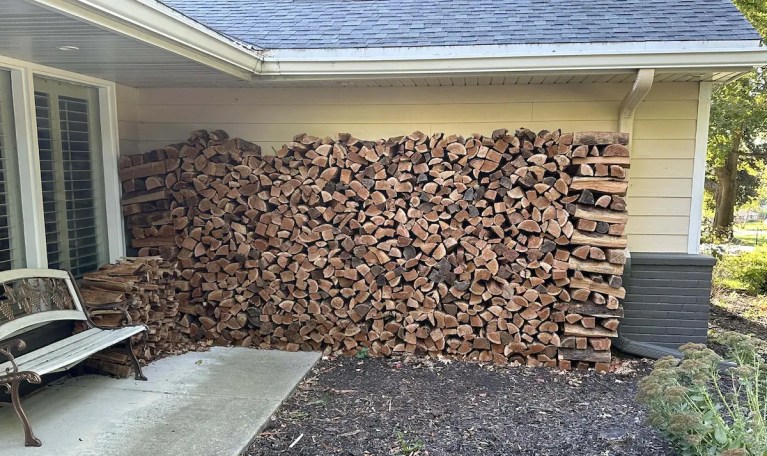
A finished row stack | Full cord placed by our crew. Level layers, straight face, ends braced.
How High Is Too High?
Keep a free-standing stack to 4 or 5 feet, and stop there. Past that height a stack of split wood gets wobbly, and wind starts to matter: we have seen customer stacks built taller go over in a storm. Advice online ranges from 4 feet to shoulder height to rounded stacks 7 feet tall, and the reason the answers disagree is that they are answering different questions. A stack inside a rack or braced against a garage wall can safely go higher because the structure is doing the holding. A stack holding itself up cannot. If nothing is bracing it but gravity, 4 to 5 feet is the ceiling.
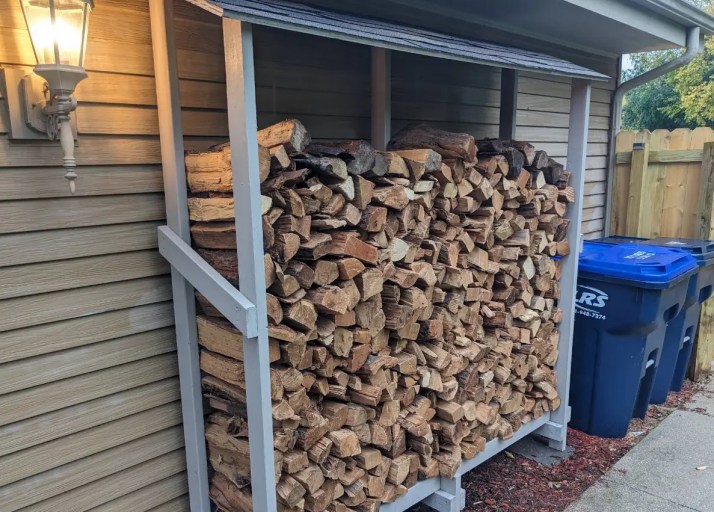
Rack against a wall | The setup most of our customers use. The rack holds the base and ends, the wall backs the stack.
End Pillars: How to Stack Firewood Without a Rack
A row of firewood wants to spread. Without something holding the ends, the outer pieces creep outward a little at a time until the stack flattens into a long triangle with wood rolling off both ends. Racks solve this automatically, which is one of the two things you are really paying for. Free-standing stacks solve it with criss-cross end pillars, and they are easier to build than they look:
1. Pick your flattest, most uniform pieces. Squared-off splits with even thickness make pillars that do not rock.
2. Lay two or three pieces side by side, parallel to each other.
3. Lay the next layer of two or three pieces on top, turned 90 degrees, so each layer crosses the one below like a log cabin corner.
4. Repeat to your target height, keeping each layer flat and level. A rocking layer low in the pillar becomes a leaning pillar at the top.
5. Build a pillar at each end, then fill the row between them, laying the row pieces so they nest against the pillars.
The pillars do three things at once: they hold the ends vertical so the row cannot drag out, they keep the end faces open to airflow, and they give you a straight edge to sight down when you check the stack for lean. If one end of your stack runs against a wall or a fence post, you only need a pillar on the open end.
Row with criss-cross ends | Each pillar layer turns 90 degrees from the one below it, like a log cabin corner.
Bark Up or Bark Down? (It Matters Less Than You Think)
Nearly every stacking guide says bark up, and almost none of them say why. The closest thing to a real answer is a Finnish forestry experiment published over a century ago that stacked matching piles bark up and bark down and weighed them for months: both dried at nearly the same rate. That matches how wood works. Moisture moves through the cut ends, not the bark, which is why every good stacking pattern leaves the ends open to the air. We cover that in our guide on how long it takes to season firewood.
The one honest job for bark is shedding some rain off the top course of an uncovered stack, like a shingle. But if bark orientation is your rain plan, you are going to lose that war: any actual top cover beats it. Set each piece whichever way it sits most stable and move on.
The Holz Hausen: What the Evidence Actually Says
The holz hausen, the round German-style wood house, is the most photographed stacking method on the internet, and the claims that come with it deserve a closer look. What holds up: it does season firewood, it is stable when built with care on a solid base, and it stores a lot of wood in a small footprint because it goes taller than a row.
What does not hold up is the famous chimney effect, the idea that the round shape pulls air up through the middle and dries wood faster than rows. No controlled study has ever demonstrated it. The research keeps finding the same boring result: wind and sun on exposed surfaces are what dry wood, which is why extension guidance from Cornell recommends single exposed rows, and why a Danish field trial found openness to airflow mattered far more than stack shape.
Now apply that to the shape itself. The center of a holz hausen is the most wind-sheltered spot in your yard, and tossing loose pieces inside the ring fills that dead-air core with wood. Builders report exactly what the airflow logic predicts: the outer ring dries fine and the center lags, sometimes staying damp enough to grow mold for a year or more.
Our verdictWe have never built a holz hausen at our yard and we do not recommend one where drying matters. Wind and airflow are the whole game in stacking, and the holz hausen shelters its own center from both. Build one because you like how it looks. A plain row in open wind will out-dry it.
Holz hausen cross-section | The outer ring gets the wind. The filled center gets almost none.
Every Stacking Method, One Verdict Each
Plenty of methods work. The question is what each one costs you in time and what it gives back. Here is the honest scorecard:
Method
Stability
Airflow
Build Speed
Verdict
Single row + criss-cross ends
High
Best
Fast
The default. What our crew builds on customer stacks.
Row in a rack
Highest
Very good
Fastest
Best choice for buyers of dry wood. No end pillars needed. Keep it off bare grass.
Full crib (all criss-cross)
High
Very good
Slow
Great as end towers. Wasteful as a whole stack: more work, less wood per foot.
Holz hausen
Medium
Weak center
Slowest
Seasons wood, but the speed claims are unproven and the center gets the least wind. Yard art, not a drying tool.
Shaker / Norwegian round
Medium
Good outer ring
Slow
Holds a lot, fussy to build and unload. Same center caveat as the holz hausen.
Lean-to against a wall
Depends on wall
Poor wall side
Fast
Fine for smaller amounts of dry wood. Leave a gap at the wall so air can reach that side.
Verdicts based on our crew's stacking work across SE Wisconsin and the published drying research. Stability ratings assume a solid, level base; nothing rates high on soft ground.
Covered stack, open sides | Roof on top, wind still moving through. The right way to shelter a stack.
Why Stacks Fall (and How to Fix a Leaning One)
After enough stack jobs, the failures sort into a short list. Soft ground under the base is the biggest one, and it is sneaky because the stack looks perfect for weeks before the ground moves. The rest: no support on the open ends, building past 5 feet free-standing, and layers that were never level to begin with, so every course above them amplifies the wobble.
The good news is that a leaning stack usually announces itself before it goes. Make a habit of sighting down the end of the row the way you would sight down a board. The face of the stack should be a straight vertical plane. When you spot pieces creeping out or the whole face starting to lean, push the offending pieces back into line, like a game of Jenga played in reverse. Caught early, a lean is a two-minute fix. Ignored, it is an afternoon of restacking, and if the cause is the ground itself, fix the base before you rebuild on it or you will be doing this twice.
FAQ: Stacking Firewood
How high should you stack firewood?
Keep a free-standing firewood stack to 4 or 5 feet. Beyond that it gets unstable and wind can take it over. Stacks braced by a rack or a wall can go higher because the structure carries the load.
Can you stack firewood on grass?
No. Grass and soft ground let the stack, or the legs of a rack, sink unevenly after rain, and an uneven base tips the whole stack. Put a rack, rails, pavers, or pallets between the wood and the ground.
Should firewood be stacked bark up or bark down?
For dry firewood it makes no noticeable difference, because moisture moves through the cut ends rather than the bark. Bark up earns its keep only on the top layer of an uncovered seasoning stack, where it acts as a rain shield.
How long does it take to stack a cord of firewood?
Our crew stacks a full cord in about 75 to 90 minutes, a face cord in about 20 minutes, and a half cord in 30 to 35 minutes. Most homeowners should plan on two to four hours for a full cord, since a cord is 560 to 600 pieces of wood. See how much firewood is in a cord for the full size breakdown.
What is the best way to stack firewood without a rack?
Build a single row on a solid base with a criss-cross pillar at each open end. Lay two or three uniform pieces per layer and turn each layer 90 degrees from the one below, like a log cabin corner. The pillars hold the ends vertical and keep the row from spreading.
Is stacking wood in a fireplace the same thing?
No. Arranging logs in a fireplace or fire pit is fire building, a different job with different rules. This guide covers stacking firewood for storage before it ever reaches the fire.
Stack It Once, Burn All Winter
A good stack is a one-afternoon job that pays off every cold morning after: solid base, straight rows, braced ends, 4 to 5 feet, wind on the cut ends. Get those right and the stack you build in September is the same stack you pull from in February.
The other half of the equation is what you put on the stack. Every piece we deliver comes out of our kilns as kiln-dried firewood, run at 265°F after 24 to 32 hours, dried to 15% moisture and USDA and WDATCP certified, so it goes onto the rack ready to burn instead of ready to season. If you are in SE Wisconsin, from Milwaukee to Waukesha County and beyond, we will bring it to your driveway: see our kiln-dried firewood delivery options and current availability.
Tyler Mainka is co-founder of Best Burn Firewood in New Berlin, Wisconsin, where he works directly in sourcing, processing, kiln-drying, packaging, and delivering firewood for residential and commercial customers. His writing is based on first-hand experience with wood species performance, moisture control, storage, and burn quality, including how different hardwoods behave in fireplaces, wood stoves, and outdoor fires. Tyler publishes practical guides to help customers choose the right firewood and burn it more safely, cleanly, and efficiently.
firewood stackinghow to stack firewoodstack of firewoodstacked firewoodstacking firewood