








What Is Kiln-Dried Firewood?
Kiln-dried firewood is firewood dried in a controlled kiln down to 15% moisture, so it is ready to burn the day you get it. Air-dried wood takes months and usually stalls around 20%. That lower number is why kiln-dried wood lights faster, burns hotter and cleaner, and arrives certified bug-free.
Field Data · Our Kilns
12 cords per session · Wisconsin heat-treatment certification HT #2019086
The operating data in this panel comes from our own kilns, not a supplier brochure.
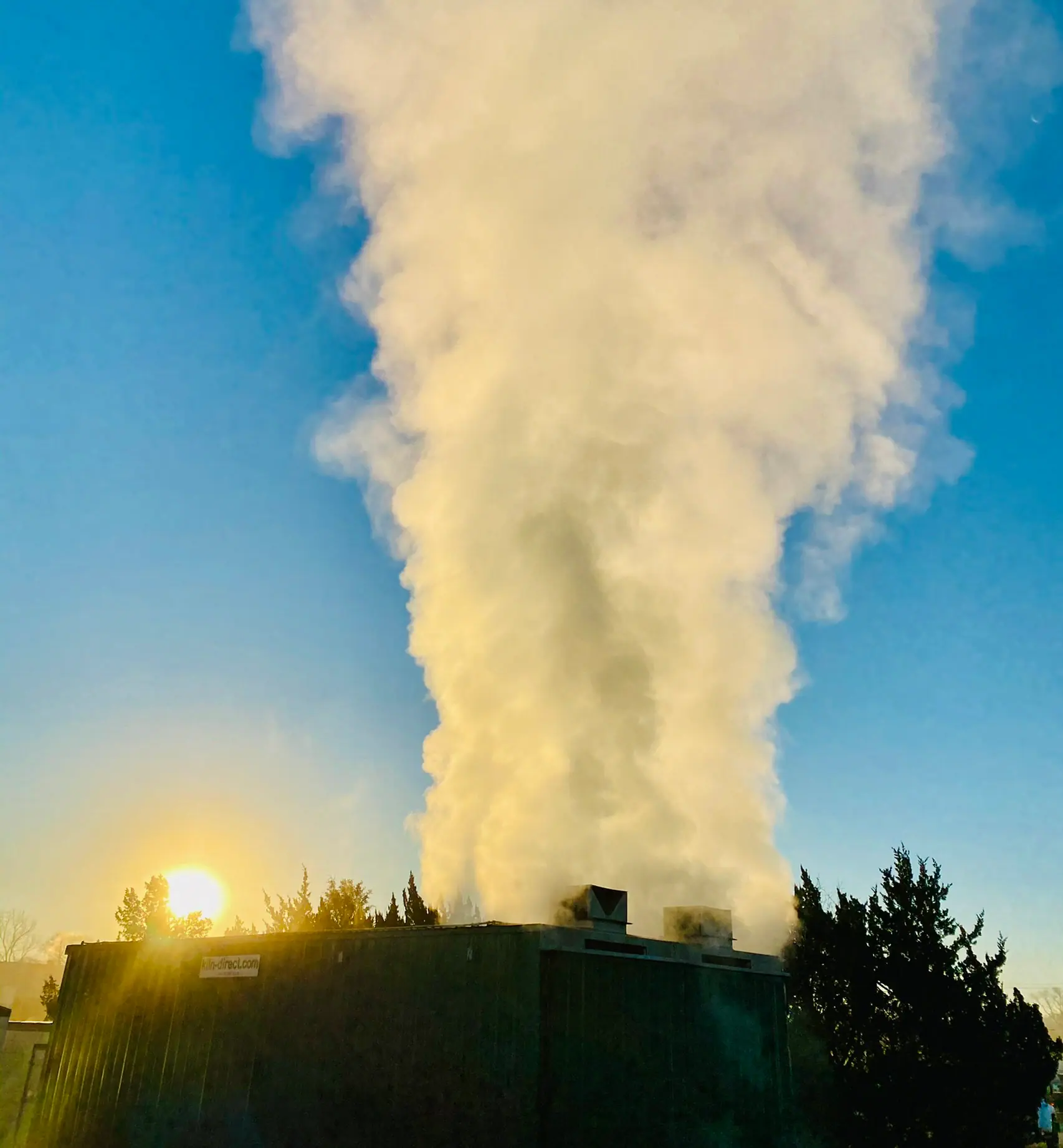
What "Kiln-Dried" Actually Means
All firewood starts as green wood, and green wood is roughly half water. Freshly cut hardwood commonly reads around 50% moisture content, which is why it hisses, smokes, and refuses to light. Before wood can burn well, that water has to go.
There are two ways to remove it. Air drying (seasoning) leaves the wood stacked outside for months and lets the weather do the work. Kiln drying puts the wood in a heated, ventilated chamber that pulls moisture out on a controlled schedule, in a day or two instead of a year, and keeps going past the point where air drying stalls.
Kiln-dried firewood, then, is simply firewood that has been dried in a kiln down to a verified moisture target. Ours is 15%. The moisture number is the whole game: it decides how easily wood lights, how hot it burns, and how much smoke it makes. You can verify it yourself on any wood you buy: here is how to check firewood moisture with a meter.

How Firewood Is Kiln-Dried
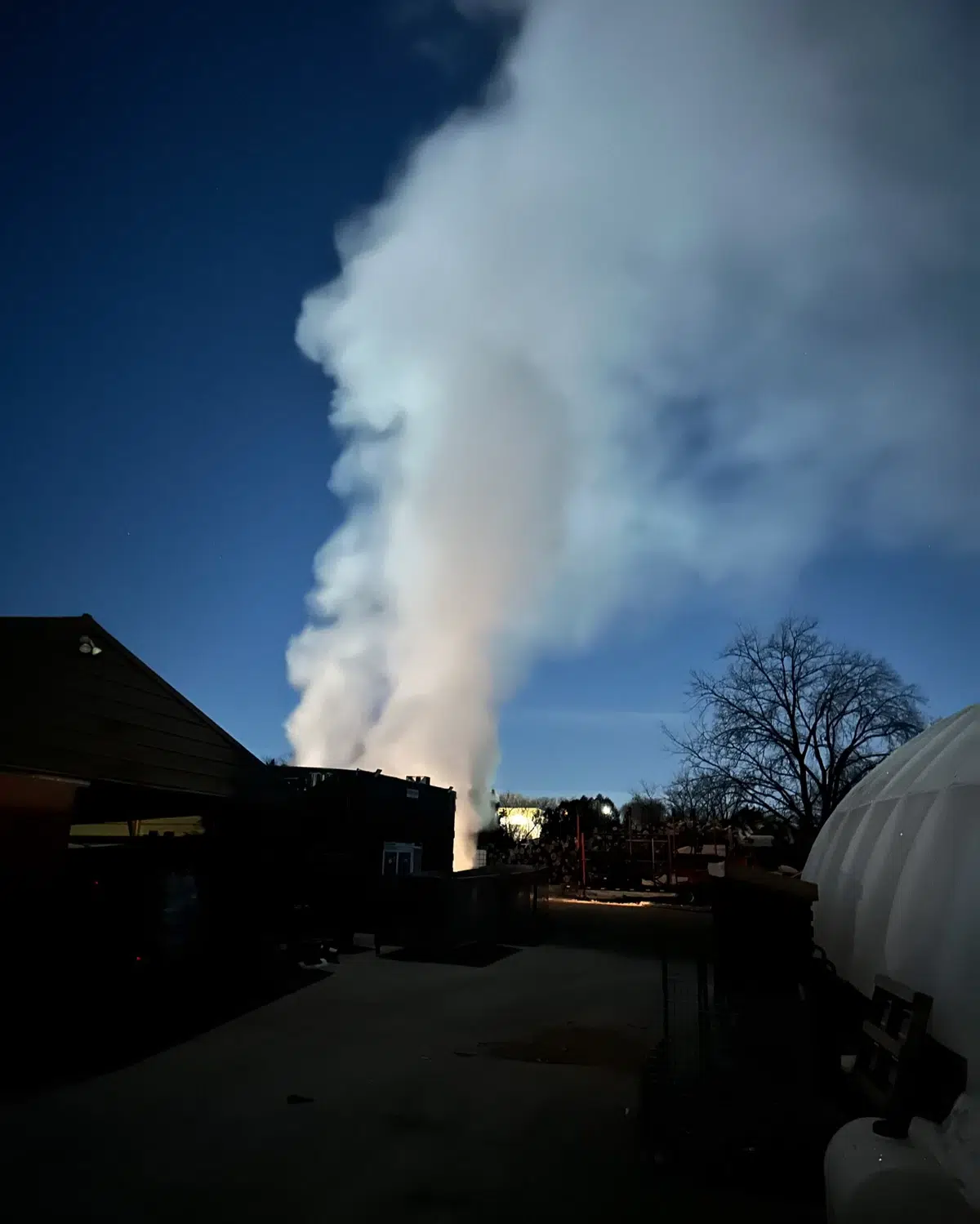
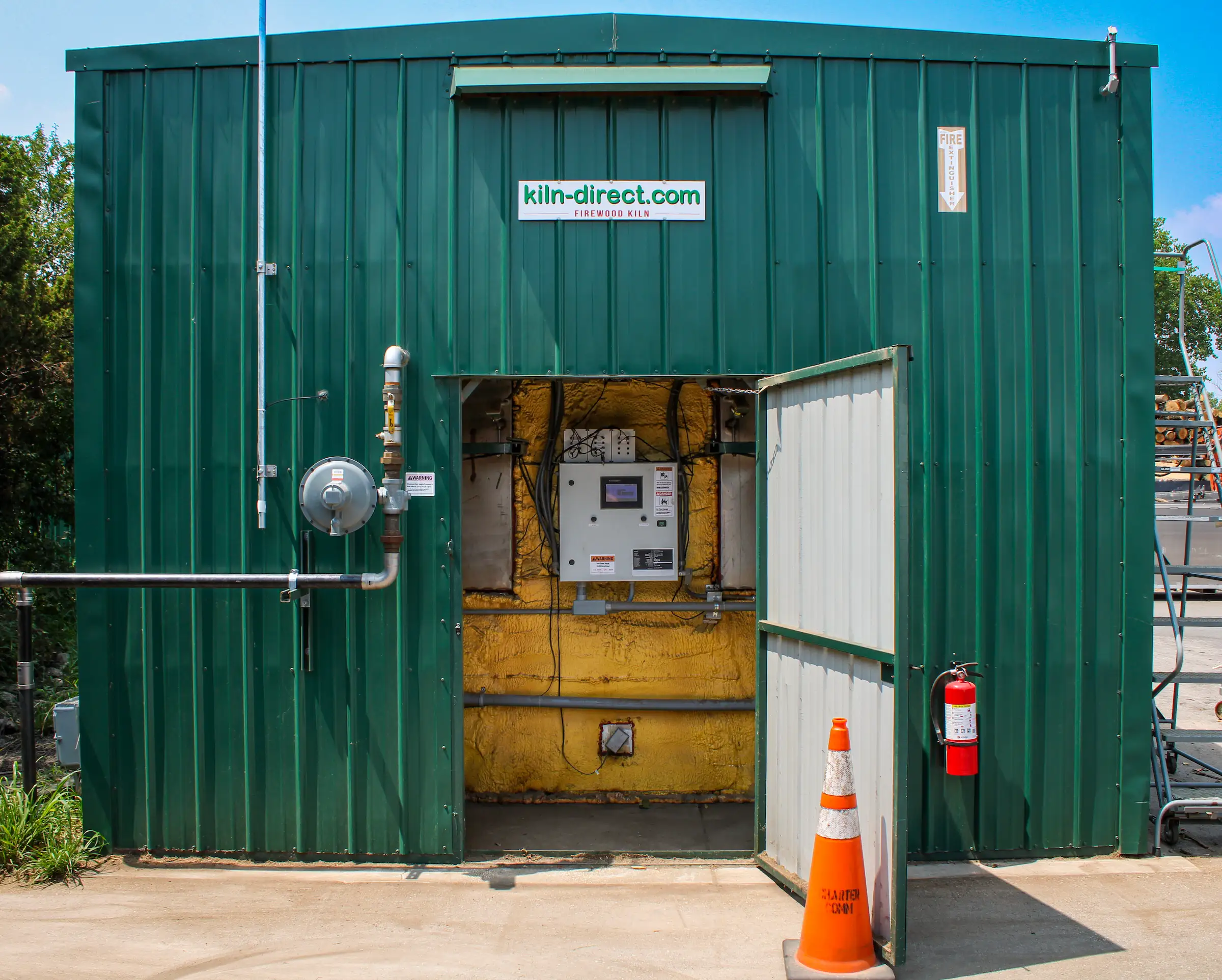
Here is exactly how we do it at our New Berlin yard. We run two Kiln-Direct firewood kilns, purpose-built chambers that hold heat at 265°F while fans move air through the stacked wood and vents carry the moisture out. Each kiln takes about 12 cords of split wood per session.
When the cycle ends, we check moisture on fresh-split faces. If a load reads above 15%, it goes back in. No load is sold on a timer; it is sold on the number.
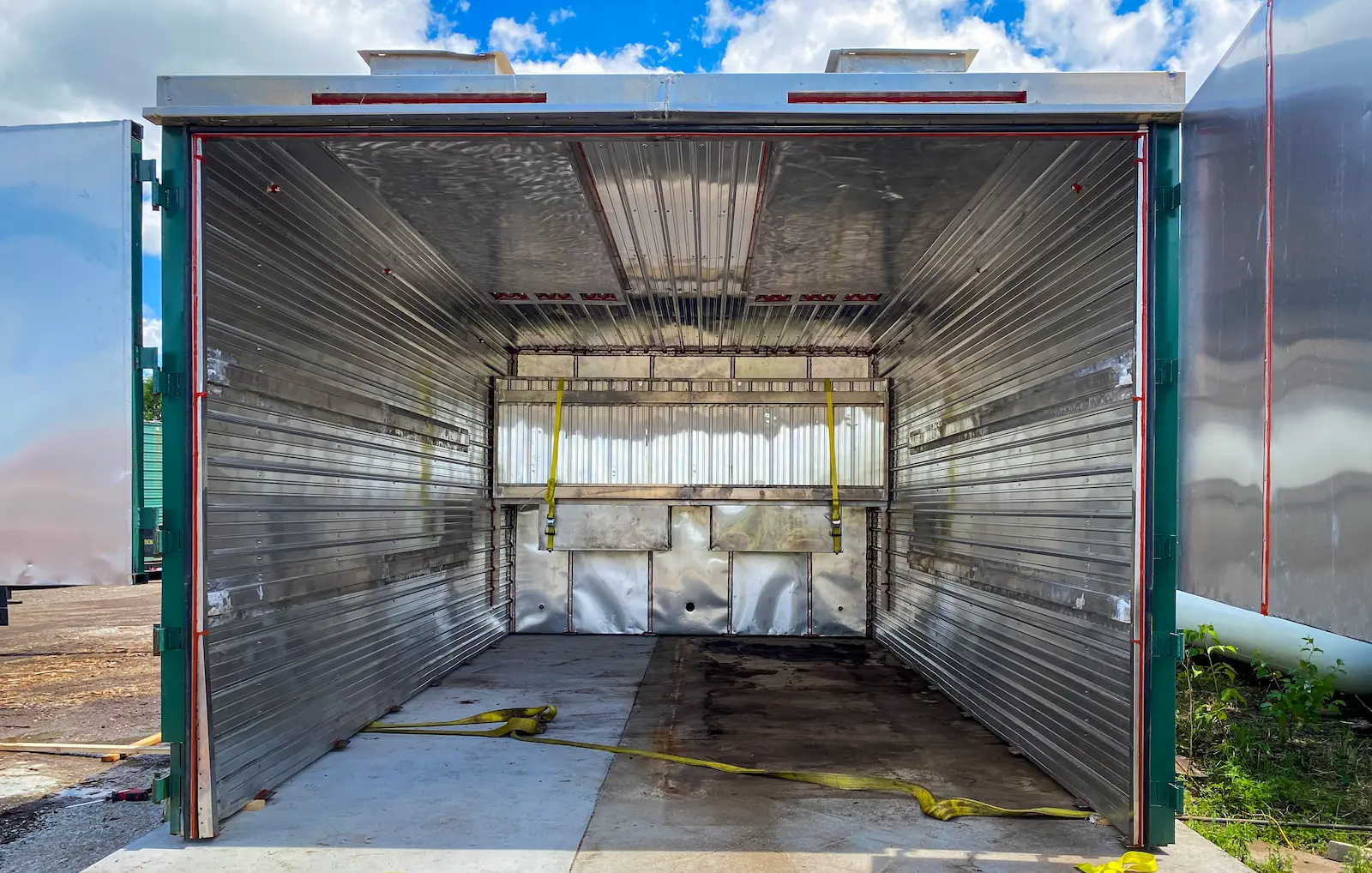
Inside a Firewood Kiln
A firewood kiln is an insulated chamber with a rear equipment bay: burners and circulation fans on one side of an insulated barrier, the stacked load on the other. Here is ours in cross-section.
How it works
- Natural gas is supplied to both burnersA shared natural-gas line supplies both burners.
- The burners cycle to hold the setpointTwo burners, 1.5 million BTU/h each, holding a 265°F chamber setpoint.
- Circulation fans force air into the chamberAir passes through openings in the insulated barrier at both basket heights.
- Heated air moves through the loadHeat supplies the energy for evaporation; the moving air carries the vapor away.
- Moisture-laden air leaves through the roofTwo roof exhaust fans remove moisture-laden air from the chamber.
Key
Front view
Two baskets wide by two high, six deep: 24 baskets, 12 cords. The side elevation above draws one of these two lanes.
Dry time depends on the species. Most hardwoods finish in 24 to 32 hours. Ash is the fastest at about 24 hours. Oak is the slowest at 36 to 40 hours, and in a Wisconsin winter it runs close to the full 40, because dense oak holds its water stubbornly. Cold weather also adds 4 to 5 hours of heat-up time before the cycle really starts.
Kiln-Dried vs Seasoned Firewood
Seasoned firewood is air-dried outdoors over months, sometimes a year or more. Done well, it gets close to burnable. The problem is the word "seasoned" promises a process, not a number: air drying typically stalls around 20% moisture or higher, and no two stacks (or two splits) finish the same.
Kiln drying replaces the guesswork with control. Every load comes out at 15%, in 24 to 40 hours, in any season, and every load matches the last one.
| Seasoned | Kiln-Dried | |
|---|---|---|
| Method | Air-dried outdoors | Controlled kiln at 265°F |
| Time | 6 to 18 months | 24 to 40 hours |
| Final Moisture | ~20% or higher, varies | 15%, verified |
| Consistency | Varies stack to stack | Identical load to load |
| Indoor-Safe | Can carry bugs and mold | Heat-treated, pest and mold free |
Seasoned wood is a real product with its own place, and it deserves its own explanation: read our full seasoned firewood guide.

Why Kiln-Dried Firewood Burns Better
Every benefit traces back to the same fact: at 15% moisture there is very little water left to fight the fire. Every pound of water still in a split boils off in your firebox first, as smoke and lost heat, before the wood gives you a flame.
Weighed the honest way: loaded cord weights in vs out, across our own kiln sessions. See the real weight difference per cord.
- Lights Faster
Dry wood catches from a single match and a little kindling. No coaxing, no firestarter bricks, no smoldering start.
- Burns Hotter, Longer
Heat that would have been spent boiling off water goes into the room instead. More usable heat from every split, and a steadier flame.
- Less Smoke, Less Creosote
Wet wood smolders, and smoldering smoke condenses in your chimney as creosote, the fuel for chimney fires. Dry wood burns clean.
- Less Popping and Spitting
Pops are pockets of moisture flashing to steam inside the wood. Less water, fewer pops. Moisture is why firewood pops.
- Consistent, Load to Load
Every cord leaves the kiln at the same 15%. The fire you build in January behaves like the one you built in October.
Is Heat-Treated, Kiln-Dried Firewood Bug-Free?
Yes. Over a full kiln cycle, 24 to 40 hours depending on species, the wood core itself reaches 220 to 230°F, which kills insects, larvae, eggs, and mold spores all the way through the split, not just on the surface. That is a treatment level air drying can never reach, no matter how long the wood sits. Because it is dry and pest-free, kiln-dried firewood is safe to store indoors: next to the stove, in the garage, or on a basement rack.
This is also why heat-treated firewood and kiln-dried firewood usually mean the same wood. The two terms describe the same load from different angles: kiln-dried refers to how dry it is, heat-treated refers to the certified core temperature it reached on the way there. Our firewood is produced at a USDA-APHIS-PPQ-certified heat-treatment facility operating under federal establishment and compliance agreement SM-WI-1233. Best Burn also holds Wisconsin DATCP heat-treatment certification HT #2019086.

Why USDA and Wisconsin DATCP Certifications Matter
Firewood is one of the most common ways invasive insects and tree diseases spread to new forests, which is why Wisconsin (through Wisconsin DATCP) and the USDA certify heat-treatment processes and restrict the movement of uncertified wood. Heat treatment works on core temperature, not surface temperature: the inside of the split has to get hot enough, long enough, to kill the pests, larvae, and disease organisms living in it. Our chambers hold 265°F, and by the end of every cycle all six wood-core probes read 220 to 230°F inside the wood itself. The standard asks for 140°F. Certified operations are audited randomly through the year and must keep kiln logs proving every load hit temperature, which is what makes the mark meaningful rather than self-claimed. It is also what lets certified firewood move legally past quarantine lines: why heat-treated wood matters when moving firewood.

 Certifying bodies. Verify Wisconsin dealers at datcp.wi.gov, ref. [1] below.
One caveat: kiln-dried wood stays at 15% only if you store it right. Left uncovered in the rain or stacked on wet ground, it can reabsorb moisture. The rules are simple:
- Rule 01 Off the GroundUse a rack or pallets. Ground contact wicks moisture up into the bottom rows.
- Rule 02 Cover the Top OnlyShield the stack from rain but leave the sides open so air keeps moving.
- Rule 03 Let It BreatheStack in a single row with airflow around it. Detail in our storage guide.
Which Species We Kiln-Dry
Every species we sell goes through the same kilns and comes out at the same 15% moisture. The species you pick changes the character of the fire, not the quality of the dry.
Dense, slow, and hot. The long-burn wood for home heating and overnight fires.
The hottest wood we carry, with clean smoke prized for smoking and grilling.
Lights easily and burns bright. The quick, lively fire for evenings at the pit.
Sweet aroma and mild cooking smoke. The ambiance and barbecue favorite.
A value blend of our hardwoods for everyday burning, dried to the same 15%.
Heat values from forestry extension tables (ref. [4] below); kiln times from our logs. To compare species in depth, see our firewood species guide.
Where to Buy Kiln-Dried Firewood
Everything described on this page is the wood we sell: kiln-dried at our New Berlin yard, verified at 15% moisture, USDA and WDATCP certified, and sold by the cord, face cord, or bundle.
We deliver kiln-dried firewood across Southeast Wisconsin, routed daily from our New Berlin yard, and pickup is always open. New here? Start at the Best Burn Firewood homepage.
Kiln-Dried Firewood FAQ
Indefinitely, as long as it stays dry. Kiln-dried wood does not expire or lose heat value sitting on a rack. Keep it off the ground, cover the top, and wood dried this year will burn just as well several winters from now.
Rain on the surface is not a problem; it dries back off in a day or two. Prolonged exposure is: wood left uncovered for weeks or stacked on wet ground can climb back above 15%. Store it covered and off the ground and it stays at 15%. If wood has already gotten soaked, our guide to burning wet and rain-soaked firewood covers how far it climbs and how long it takes to dry back down.
If you value your time and your chimney, yes. You pay somewhat more per cord than for seasoned wood, and in exchange every split lights fast, burns hot, produces less creosote, and carries no bugs or mold into your home. For what that costs right now, see our current firewood prices.
In our kilns, 24 to 40 hours at 265°F depending on species. Ash finishes in about 24 hours, most hardwoods in 24 to 32, and dense oak takes 36 to 40. Compare that with 6 to 18 months for air drying, which still stops short of 15%.
For burning, yes. Kiln-dried wood is drier (15% vs roughly 20% or higher), consistent load to load, and heat-treated so it is free of insects and mold, which seasoned wood cannot guarantee. Read the full comparison in our seasoned firewood guide.
In practice, usually yes. Kiln-dried describes how dry the wood is; heat-treated describes the certified core temperature it reached during the cycle. Firewood can technically be heat-treated without being dried to a low moisture target, but a certified kiln run does both at once. Ours is dried to 15% and heat-treated under two separate certifications: USDA APHIS PPQ establishment SM-WI-1233 at the federal level, and Wisconsin DATCP certificate HT# 2019086 at the state level.
Kiln-fired is a common mix-up for kiln-dried. Nothing is fired or burned in the process. The wood sits in a heated chamber while fans move air through it and vents carry the moisture out. "Fired" belongs to pottery kilns, where clay is actually vitrified by heat. Firewood kilns only dry.
Who Measured This

Tyler Mainka
Co-FounderTyler co-founded Best Burn Firewood in 2016 and handles the company's research, measurement, and published technical content. Figures cited on this site come from the operation's own kiln logs, moisture readings, and yard measurements rather than secondhand sources.
LinkedIn
Brady Mainka
Co-Founder, PresidentBrady co-founded Best Burn Firewood in 2016 and oversees all operations, including the kiln process. He set the cycle times for every species we run, dialed in through ten years of aggregated data rather than copied from a manufacturer's spec sheet, and he has final say on whether a load ships or goes back in.
LinkedInReferences & Sources
Field-guide endnotes. Kiln temperatures, dry times, moisture readings, and cord weights on this page are measured at Best Burn Firewood, New Berlin, WI; outside standards below.
- Wisconsin DATCP, firewood certification and movement rules: datcp.wi.gov / Firewood
- USDA APHIS, heat-treatment standards for moving firewood: aphis.usda.gov / ACIR reference document
- Don't Move Firewood campaign (The Nature Conservancy), on invasive pests in firewood: dontmovefirewood.org
- Forestry extension tables on wood moisture and heat value per cord: Penn State Extension, wood heating
- Wisconsin DATCP, firewood dealer certification program: datcp.wi.gov / Firewood Dealer Certification
- USDA Forest Service, heat treatment of firewood, case studies on thermal mapping and wood-core probe monitoring: research.fs.usda.gov / Heat Treatment of Firewood
Burn the wood this page is about
Order Kiln-Dried Firewood ›Want to keep learning? Explore more guides in Woody's University.




