Face Cord vs Full Cord vs Rick: What You're Actually Buying
Face cord, full cord, rick: three terms that get used interchangeably by sellers, but they are not the same thing, and the difference can cost you real money. One of them is legally defined. The others are not. Here is how to tell them apart, compare prices across sellers, and know exactly what you are getting before the truck pulls away.
Most people ordering firewood for the first time run into the same wall of terminology: cord, face cord, half cord, rick. Sellers use these terms interchangeably, and not always with your best interests in mind. One of them has a legal definition. The others do not. Knowing which is which before you hand over money is the difference between getting exactly what you paid for and wondering where your wood went.
For a full breakdown of cord dimensions, volume calculations, and how much firewood different amounts actually provide, see our cord of firewood guide. This post focuses on the three terms buyers encounter most: face cord, full cord, and rick. What they mean, how they compare, and how to use that knowledge when you are getting quotes.
What Is a Full Cord of Firewood?
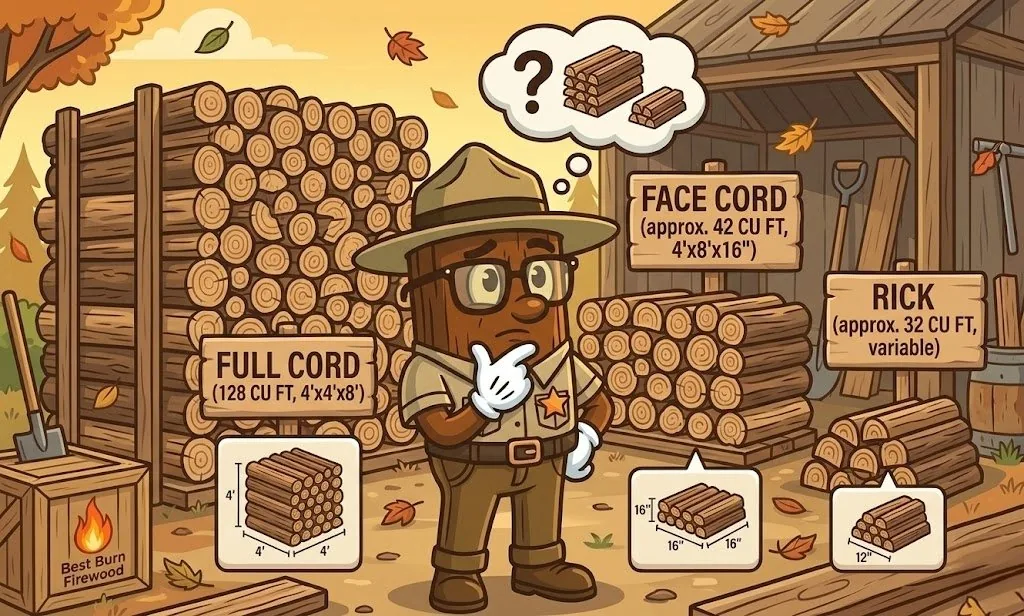
A full cord is the only firewood measurement backed by law. In Wisconsin, the cord is defined under Administrative Code ATCP 91 as a stack measuring 4 feet high, 4 feet deep, and 8 feet long, totaling 128 cubic feet of tightly stacked wood. Most other states have similar statutes on the books.
4 ft high × 4 ft deep × 8 ft long = 128 cubic feetThe legal standard in Wisconsin and most U.S. states. Every other firewood unit is either a fraction of a cord or an informal term with no legal standing.
This is the baseline. Starting here makes everything else easier to understand, and it gives you a reference point that any seller in the country has to answer to if pressed. For the full picture on cord dimensions, what a cord of firewood weighs, and how much it burns through in a typical Wisconsin winter, see our complete firewood cord measurement guide.
What Is a Face Cord of Firewood?
A face cord is one row of logs stacked 4 feet high and 8 feet wide, at a standard log depth of 16 inches. That puts it at roughly 42 cubic feet, about one-third of a full cord.
If you own a standard 8-foot firewood rack, a face cord fills it exactly. That is not a coincidence. The most common residential firewood rack on the market is built to hold one face cord, which is also why the face cord became the default residential delivery unit across much of the Midwest. The rack and the measurement were designed for each other.
The easiest way to picture the relationship: a full cord is three of those racks loaded the same way. When first-time buyers hear that, the reaction is almost always the same: oh wow, that is a lot of wood. It is. Most households burning a fireplace a few times a week through a Wisconsin winter will go through one to two face cords in a season, not a full cord.
What Is a Rick of Firewood?
A rick is a regional term with no legal definition. In most markets it is used interchangeably with face cord, meaning a stack 4 feet high, 8 feet wide, and 16 inches deep. But there is no law or regulation that requires a rick to measure any specific dimensions.
In Wisconsin, the only legally recognized firewood measurements are the cord and its fractions, defined under ATCP 91. Firewood sold in this state must be quoted by the cord, a fraction of a cord, or cubic foot. The word rick does not appear anywhere in that code, because it is not a defined unit of measure.
Rick has no legally enforceable size standard in Wisconsin.A seller quoting by the rick is quoting a unit whose depth can vary from seller to seller with no obligation to disclose it. Before ordering from any seller using that term, ask for the depth in inches. A seller who cannot give you a specific number without hesitation is telling you something.
Face Cord vs Full Cord: The Price Comparison That Actually Matters
This is where the terminology confusion costs buyers real money. A seller quoting $350 per "cord" could mean a face cord (one-third of a full cord) or a full cord (three times as much wood). Without knowing which unit they are using, comparing quotes across sellers is a guessing game.
How to normalize any firewood quoteTo compare a face cord price against a full cord quote: multiply the face cord price by 3 To compare a full cord price against a face cord quote: divide the full cord price by 3Example: Seller A quotes $320 per face cord ($960 per full cord equivalent). Seller B quotes $850 per full cord. Seller B is cheaper for the same amount of wood — but only if you know to do the math.
Unit
Dimensions
Approx. Cu Ft
Fraction of Full Cord
How to Compare Prices
Full Cord
4 ft H × 4 ft D × 8 ft L
~128
1 (legal standard)
Divide by 3 to get the face cord equivalent cost
Face Cord
4 ft H × 16 in D × 8 ft L
~42
1/3 of a cord
Multiply by 3 to compare against full cord quotes
Rick
4 ft H × depth varies × 8 ft L
Varies
Typically ~1/3 cord
Confirm depth in inches before running any math
Prices vary by region, species, and whether the wood is kiln-dried or air-seasoned. The conversion math is the tool. Apply it to any quote you receive before comparing across sellers.
When getting quotes, ask directly: are you quoting a face cord or a full cord? Any seller running a legitimate operation will answer without hesitation. If the response is vague, references a rick without specifying the depth, or sidesteps the question, ask for clarification before committing.
What Best Burn Firewood Actually Delivers
We sell firewood in four sizes: full cord, half cord, face cord, and half face cord. Every one of those is a legally defined fraction of a cord under Wisconsin ATCP 91. We do not sell by the rick because it is not a legal unit of measure in Wisconsin, and we do not think customers should have to guess at what they are getting.
BBF firewood sizesFull Cord: 4 ft H × 4 ft D × 8 ft L (128 cu ft — 3 full racks) Half Cord: 4 ft H × 16 in D × 12 ft L (64 cu ft — 1.5 racks) Face Cord: 4 ft H × 16 in D × 8 ft L (~42 cu ft — 1 rack) Half Face Cord: 2 ft H × 16 in D × 8 ft L (~21 cu ft — half a rack)
When we quote a face cord, we tell customers it stacks out to 8 feet long, 4 feet tall, and 16 inches deep, which is exactly the size of a standard firewood rack. A full cord is three of those. Everyone lands on the same reaction when they picture it: the amounts are bigger than they expected, especially a full cord.
Our trucks hold up to 6 face cords. A typical residential order fills about 20 percent of that capacity. We load every delivery to measured containers on the truck, so we know the amount is right on nearly every run. When a customer ever has a question about their delivered volume, we ask them to stack the wood out and measure it. The math is almost always there. In the rare case we ever do fall short, we make it right at our cost, no argument.
Every cord we deliver has been processed through our Kiln-Direct kilns at 265 degrees F for 24 to 32 hours, consistently below 15 percent moisture. USDA certified, WDATCP HT# 2019086.
Frequently Asked Questions
How many face cords are in a full cord?
Three face cords equal one full cord. A full cord is 4 x 4 x 8 feet (128 cubic feet). A face cord is 4 feet high, 8 feet wide, and 16 inches deep, which is roughly one-third of that total volume.
Is a rick the same as a face cord?
In most markets a rick is described using the same dimensions as a face cord (4 x 8 feet with a 16-inch depth), but a rick has no legal definition and no enforceable size standard. The depth can vary from seller to seller with no obligation to disclose it. Always confirm the depth in inches before ordering from any seller quoting by the rick.
What is the standard depth of a face cord of firewood?
The standard depth is 16 inches, which matches the standard log length for most residential firewood and fits a standard 8-foot firewood rack. Some sellers cut to 12 or 18 inches depending on the end use. Confirm the log length matches your firebox or fireplace opening before ordering.
How do I know if a seller is quoting a face cord or a full cord?
Ask directly: "Is that price for a face cord or a full cord?" A legitimate seller will answer without hesitation. If the response is vague, uses the word rick without specifying a depth, or sidesteps the question, press for a clear answer before any money changes hands.
How much does a face cord of firewood cost?
Pricing varies significantly by region, wood species, and whether the wood is kiln-dried or air-seasoned. In the Midwest, face cord prices typically land somewhere between $150 and $350 or more depending on those factors. Always convert any quote to a per-full-cord equivalent before comparing across sellers, regardless of which unit they are using.
Know what size you need? View current pricing and schedule delivery across SE Wisconsin.
Tyler Mainka is co-founder of Best Burn Firewood in New Berlin, Wisconsin, where he works directly in sourcing, processing, kiln-drying, packaging, and delivering firewood for residential and commercial customers. His writing is based on first-hand experience with wood species performance, moisture control, storage, and burn quality, including how different hardwoods behave in fireplaces, wood stoves, and outdoor fires. Tyler publishes practical guides to help customers choose the right firewood and burn it more safely, cleanly, and efficiently.
face cord vs full cordface cord vs rickface cord vs rick vs full cordrick cord