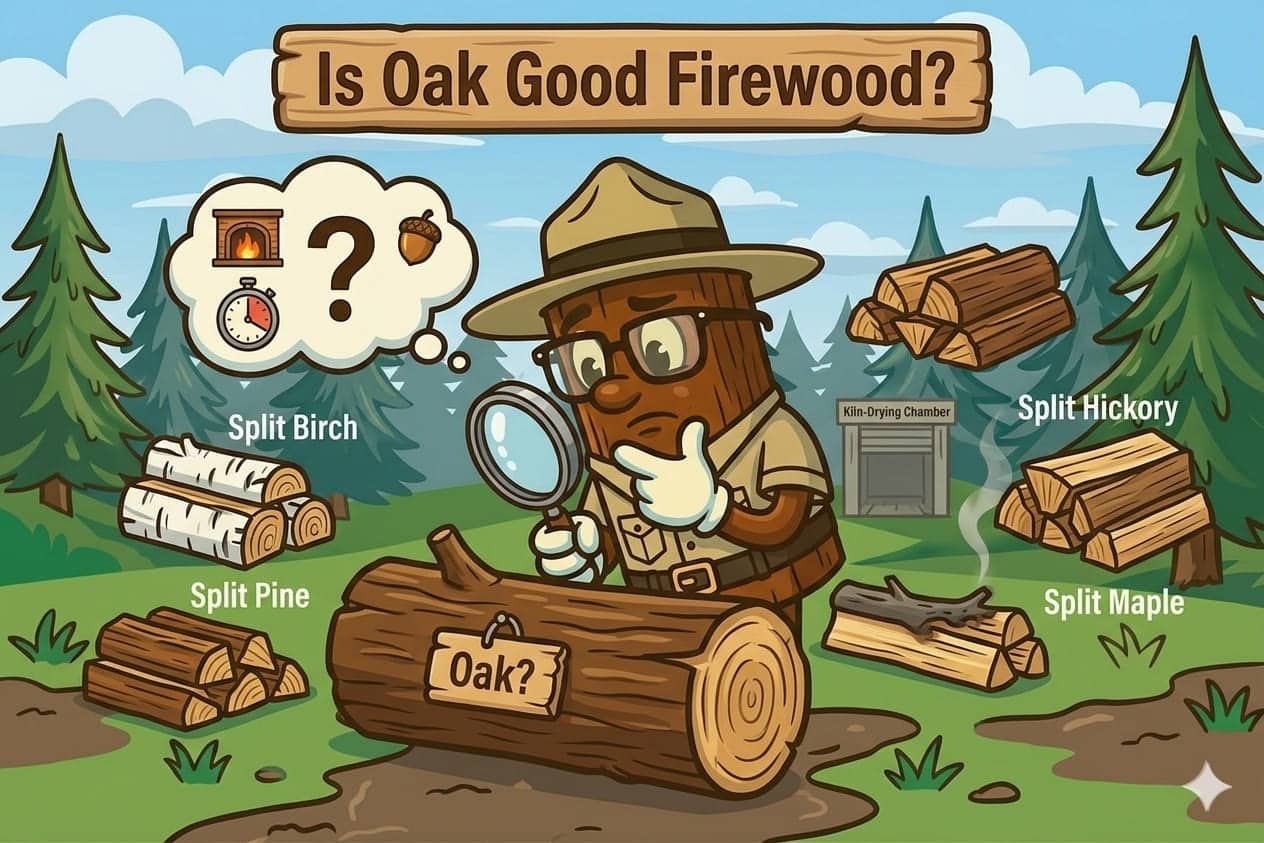
Is Oak Good Firewood? Heat Output, Burn Time & Seasoning Tips
Oak is the go-to firewood for overnight burns and serious home heating — but it carries more moisture than almost any other hardwood, and red oak and white oak don't perform the same. We break down BTU by species, what it actually takes to dry oak properly, real kiln data from our operation, and why restaurants request oak more than any other species.
Tyler M
9 min read
Last Updated:
March 16, 2026
Oak is the go-to firewood for overnight burns and serious home heating — but it carries more moisture than almost any other hardwood, and red oak and white oak don't perform the same. We break down BTU by species, what it actually takes to dry oak properly, real kiln data from our operation, and why restaurants request oak more than any other species.
Oak is one of the best firewood species you can burn. It's dense, it produces excellent heat, it holds coals for hours, and it burns with minimal sparking or smoke when properly dried. If you heat your home with a wood stove or fireplace and you want a fire that lasts through the night without constant reloading, oak is the wood that gets you there.
The caveat — and it's an important one — is that oak carries more moisture than almost any other hardwood when it's fresh. That means seasoning it properly is critical, and most people underestimate how long it actually takes. We process thousands of cords of oak per year at our operation in New Berlin, Wisconsin, and the difference between properly dried oak and under dried oak is night and day.
This guide covers the real numbers, the differences between red and white oak, what it takes to actually get oak dry enough to burn well, and why it's the most requested species from our restaurant customers.
Oak Firewood at a Glance
Best oak for heat: White oak — 26–29 million BTU per cord
Most common: Red oak — 24–25 million BTU per cord, widely available
Burn time: Very long — oak is the go-to species for overnight fires
Good for fireplaces? Yes — low sparking, low smoke, excellent coals
Aroma: Mild and earthy, not overpowering
Seasoning time: 12–24 months air-dried; kiln-dried is ready immediately
Best use: Primary home heating, overnight burns, wood stove use, smoking and grilling
Red Oak vs White Oak: What's the Difference?
If someone sells you "oak firewood," you're most likely getting red oak, white oak, or a mix of both. They're different trees with different characteristics, and it's worth knowing what you're working with.
Red oak is the more common of the two in most parts of the eastern U.S. and the Upper Midwest. It's slightly less dense than white oak, which means it produces a bit less heat per cord and burns somewhat faster. The tradeoff is that it seasons faster and is generally easier to split due to a straighter grain. Red oak also has a reputation for a sour, vinegar-like smell when it's green or freshly cut — more on that below.
White oak is denser, heavier, and produces more heat per cord. It also takes noticeably longer to dry, both in open air and in a kiln. The grain is tighter, which makes it more resistant to moisture — great for the tree, harder for the person trying to season it. White oak is also tougher to split by hand, especially once it's dry.
At our operation, we process whatever our logging partners bring us — which means our oak loads are typically a natural mix of red and white. For most customers, that's ideal. You get the best of both: the heat and density of white oak alongside the easier-burning characteristics of red oak.
Both species grow abundantly in southeastern Wisconsin. Oak is the dominant hardwood in our region's forests, which is part of why it's so readily available as firewood here.
Oak Firewood Heat Output (BTU by Species)
Heat output is measured in BTUs (British Thermal Units) per cord. As with all firewood species, the exact number depends on growing conditions, density, and how the wood was dried — but the ranges below are consistent across forestry references:
For context, hickory falls in the 27–30 million BTU range, sugar maple around 24–29 million, and cherry around 20–22 million. Oak sits right at the top of the practical firewood spectrum — not quite as hot as hickory pound-for-pound, but more widely available and easier to source in large quantities.
The weight numbers matter too. A full cord of seasoned white oak weighs roughly 4,000 pounds — that's a heavy delivery. You'll feel the difference compared to a cord of birch or ash. Heavier wood means more fuel mass per cord, which means more heat and longer burn times.
How Oak Burns: Coals, Smoke & Overnight Heat
This is where oak earns its reputation. Oak's burn characteristics are what make it the default choice for serious home heating.
Coaling: Oak produces some of the best coals of any firewood species. A well-established bed of oak coals will hold heat for hours after the flames die down. If you load your wood stove with oak before bed, you'll often wake up to a bed of hot coals that can be revived with kindling in minutes. That's oak's signature advantage — it doesn't quit when the fire does.
Burn time: Because of its density, oak burns slowly and steadily. A single large oak split can burn for hours. You won't be getting up every 45 minutes to add wood, which is the reality with lighter species like birch or pine.
Smoke and sparking: Properly dried oak burns clean. It produces low to moderate smoke that isn't heavy or acrid, and it throws very few sparks. This makes it safe for open fireplaces and excellent for wood stoves where you want a controlled, predictable burn.
The red oak smell: Green red oak has a noticeable sour, vinegar-like smell. This is normal — it comes from tannic acid in the wood. Some articles online warn about this as a major negative, but here's the reality: the smell is only an issue with green or poorly seasoned red oak. Once red oak is properly dried — whether air-seasoned for 18+ months or kiln-dried — the smell is dramatically reduced. We've sold thousands of cords of kiln-dried oak and this is not something our customers report as an issue.
Creosote: Like all firewood, oak will produce creosote if burned wet. But when dried below 20% moisture, oak produces minimal creosote buildup. One thing to be aware of: because oak burns slowly, smoke can linger in the chimney longer than with faster-burning species, which means annual chimney cleaning is still important. You can test your oak's moisture content with a moisture meter before burning — you want to be under 20%.
Seasoning Oak Firewood (Or Skip the Wait with Kiln-Dried Oak Firewood)
This is the section that matters most if you're buying or processing oak. Oak's biggest drawback is how long it takes to dry. Most other firewood gets a paragraph about seasoning. Oak needs a real conversation.
Why oak takes so long to dry: Oak is one of the wettest hardwoods when freshly cut. A green cord of red oak weighs approximately 4,900 pounds. After proper seasoning, that same cord weighs around 3,500 pounds. That means roughly 1,300 to 1,400 pounds of water — per cord — needs to evaporate before the wood is ready to burn. White oak holds even more moisture and takes longer to release it because of its tighter grain structure.
For air-seasoning, plan on a minimum of 12 months for red oak and 18 to 24 months for white oak. Some experienced burners recommend a full two years for white oak, especially for larger splits. If you try to burn oak that hasn't been adequately dried, you'll get sluggish fires, excessive smoke, poor heat output, and faster creosote buildup. It's not worth it.
Tips for air-seasoning oak:
Split it green — oak is much easier to split before it dries, and the exposed faces speed up moisture loss
Stack off the ground on pallets or a firewood rack
Leave space between rows for airflow — don't pack it tight
Cover the top only — leave the sides open to wind and sun
Test with a moisture meter before burning — under 20% is the target
The kiln-dried alternative. At Best Burn, we kiln-dry our firewood at 260°F using USDA-monitored kilns. We track every load with six temperature probes across the chamber. Here's what the data shows about oak: a recent 12-cord load of oak required a 42-hour kiln cycle to reach our target moisture content. By comparison, a 12-cord load of ash in the same kiln, at the same temperature, reached the same moisture level in 27 hours — 15 fewer hours of run time. That 15-hour difference tells you exactly how much more moisture oak holds and why shortcutting the drying process doesn't work with this species.
The kiln process also kills insects, mold, and disease — which is especially important in Wisconsin, where firewood movement is regulated to prevent the spread of invasive species like emerald ash borer (Wisconsin DNR firewood rules).
If you've been burned by poorly seasoned oak in the past — smoky fires, hard to light, hissing and sizzling — the wood wasn't ready. Kiln-dried oak eliminates that problem entirely. Learn more about what kiln-dried firewood is and why it matters.
Splitting Oak: Tips from Our Operation
Oak's splitting behavior varies between species and depends on whether the wood is green or dry.
Red oak has a relatively straight grain and splits cleanly when green. It's one of the more cooperative hardwoods to work with by hand. Once it's dry, though, the difficulty goes up — seasoned red oak can be stubborn, especially pieces with knots or forks.
White oak is tougher in any condition. The grain is tighter and more interlocked, which makes it resistant to clean splits. Dry white oak is one of the hardest common firewood species to split by hand. If you're processing your own oak, a hydraulic splitter is highly recommended for white oak.
The universal advice: split oak green, as soon as possible after cutting. You'll make your life easier and the wood will start drying faster with more exposed surface area.
Cooking and Smoking with Oak Firewood
Alt text: "Oak firewood being used for wood-fired cooking and smoking meat"
Oak is the backbone of professional wood-fired cooking — and it has been for a long time. If you've eaten at a wood-fired steakhouse or a BBQ joint that takes their craft seriously, there's a good chance they were burning oak.
The reason is straightforward: oak provides steady, high heat with a mild, earthy smoke flavor that complements food without overpowering it. It's especially good with beef, pork, and poultry. Unlike stronger-flavored woods like hickory or mesquite, oak lets the meat be the star while still adding the depth that only live fire can provide.
Most of the wood-fired restaurants we supply in the Milwaukee area specifically request oak. When a restaurant calls us, oak is usually the first species they ask for — they want the BTU output for consistent cooking temperatures and the clean burn that doesn't leave off-flavors on the food.
For home use, oak is excellent in a charcoal chimney starter, a smoker, or a fire pit grill setup. It makes strong, long-lasting coals that hold steady cooking temperatures. If you're smoking a brisket or pork shoulder over a long cook, oak gives you the stability to maintain temperature without constant tending.
Oak Wilt and Firewood Quality: What Buyers Should Know
This one doesn't get talked about much in firewood articles, but it matters — especially in Wisconsin.
Oak wilt is a fungal disease that's killing oak trees across the state. As of 2026, the Wisconsin DNR has confirmed oak wilt in 66 of the state's 72 counties. The disease spreads through root systems and through sap-feeding beetles that carry spores to fresh wounds on healthy trees. It moves fast — a red oak can go from healthy to dead in a matter of weeks once infected.
Why this matters for firewood buyers: oak trees killed by oak wilt can develop partial rot, especially along the edges and under the bark. This compromised wood doesn't burn as well, doesn't hold heat as long, and can introduce mold and decay into your firewood stack. Not all suppliers screen for this.
At Best Burn, we pay premium pricing for live, green oak only. We reject dead oak and wilt-killed oak from our logging partners. It costs us more, but it means the oak you receive from us is structurally sound, dense, and free of rot. That's a quality standard we take seriously.
How Oak Compares to Other Firewood Species
Oak is often treated as the gold standard for firewood, but how does it actually stack up against the other species we sell?
The short version: oak is your workhorse. It's not the easiest to light and it takes the longest to season, but nothing else gives you the same combination of heat, burn time, and coaling. If you want a fire you can load up and walk away from, oak is it.
Most of our customers don't burn one species exclusively — they buy our Mixed Hardwoods blend and get a natural combination of oak, maple, ash, cherry, hickory, and birch. Oak provides the backbone, and the lighter species make it easier to get started.
Frequently Asked Questions About Oak Firewood
Is oak the best firewood?
For sustained home heating and overnight burns, oak is hard to beat. Hickory edges it out on raw BTU in some comparisons, but oak is more widely available and more practical to source in large quantities. For most homeowners, oak is the top choice — either on its own or as the primary species in a mixed hardwood load.
How long does oak take to season?
Red oak needs 12 to 18 months of air-drying. White oak needs 18 to 24 months, sometimes longer for large splits. Kiln-drying brings both down to about 42 hours. The key is reaching below 20% moisture content — don't guess, test with a moisture meter.
Is red oak or white oak better for firewood?
White oak produces more heat per cord and burns longer. Red oak is more widely available, easier to split, and seasons faster. Both are excellent firewood. Most loads contain a natural mix of both, which gives you the benefits of each.
Does oak burn clean?
Yes — when properly dried. Well-seasoned or kiln-dried oak produces low smoke, minimal sparking, and relatively little creosote. Green or under dried oak, on the other hand, will smoke heavily and is one of the worst offenders for creosote buildup due to its high moisture content.
Is oak good for smoking meat?
Oak is one of the most popular smoking woods in the country. It provides a mild, earthy flavor that works with nearly any protein — especially beef, pork, and poultry. It's the standard wood at most serious BBQ operations and wood-fired restaurants.
Can you burn oak in a fireplace?
Absolutely. Oak is one of the safest and most effective species for indoor fireplaces. It burns steadily, produces excellent coals, and throws very few sparks. Just make sure the oak is properly dried before burning indoors — moisture content under 20% is the standard.
Ready to Burn Oak This Season?
If you're in southeastern Wisconsin, our kiln-dried oak firewood is dried to below 17% moisture, pest-free, and ready to burn the day it arrives. Oak is our #2 seller behind Mixed Hardwoods — and the top choice for our restaurant customers.
Tyler M is the Co-Founder of Best Burn Firewood in Wisconsin, where he works directly in sourcing, processing, kiln-drying, packaging, and delivering firewood for residential and commercial customers. His writing is based on first-hand experience with wood species performance, moisture control, storage, and burn quality, including how different hardwoods behave in fireplaces, wood stoves, and outdoor fires. Tyler publishes practical guides to help customers choose the right firewood and burn it more safely, cleanly, and efficiently.
firewood oakis oak good firewoodkiln dried oak woodoak firewoodoak firewood for saleoak woodoak wood in fireplace
Related Blog Posts
Best Firewood for Pizza Ovens: Heat Control + Coal Management
Kiln-dried oak is the best wood for a pizza oven, but species choice is only half the equation. Heat control and coal management are what actually separate a perfect crust from an inconsistent one. Here is what Wisconsin's top wood-fired restaurants use, and how they do it.
Is Maple Good Firewood? Heat Output, Burn Time & What to Expect
Maple is one of the most common firewood species in Wisconsin — but sugar maple and silver maple perform very differently. We break down the real BTU numbers by species, how maple burns, seasoning vs kiln-dried, and where maple fits in a mixed hardwood load.
Is Birch Good Firewood? Heat Output, Burn Time, What to Expect
Birch is good firewood for fireplaces and wood stoves, offering high heat and a steady burn. Learn heat output, burn time, and how birch compares to hardwoods.
Safely Transporting Firewood: Key Rules You Must Know
Have you ever considered the type of firewood you use for your fireplace or grill? The quality of your firewood can significantly impact your fire experience, whether it’s the ease of lighting the fire, the longevity and intensity of the burn, or even the aroma produced. Enter kiln-dried firewood, a premium firewood option that guarantees an optimal burn experience for any occasion.
Is Ash Good Firewood to Burn? Discover Its Benefits!
Is ash good firewood to burn? Learn about its benefits, including efficient heat output and low smoke production. A perfect choice for your firewood needs!
Cleaner Fires: Using a Moisture Meter for Firewood
Ensure cleaner, more efficient fires with a moisture meter for firewood. Learn how to choose the right meter to improve your wood-burning experience today!
Wondering how to start a fire with wet wood? Our fire-loving mascot Woody is here to show you the tricks, tools, and tips to turn damp logs into a crackling success. Let’s fire it up... rain or shine.
Why does firewood pop during burning? Firewood pops during burning because moisture and resin trapped inside the wood turn into steam when heated, creating pressure that bursts through cracks. Read the article below, to find out why your firewood is popping!
What Firewood Is Best for Burning In Your Fireplace?
From our experience, Oak and Hickory are the best firewood choices for a long-lasting, efficient burn in your fireplace. But every home and fire is different—read our guide below to see which firewood is best for your needs! 🔥
After experiencing firewood deliveries filled with dirt and debris, we now hand-pick and load each order to ensure you receive clean, high-quality wood. This guarantees the exact amount of wood without the extra mess.
Call us at any time of the year, whether it's in the hot summer or freezing winter.
100% kiln dried Wisconsin Firewood for Sale.
Stacking of your firewood delivery upon request
FIREWOOD Delivery To following areas
South Eastern Wisconsin and Waukesha County
Firewood delivery in South Eastern Wisconsin and Waukesha County