Is Maple Good Firewood?
Yes, maple is excellent firewood. Hard maple (sugar maple) is one of the better heating woods available — it burns hot, produces strong coals, and gives off a mild, sweet-smelling smoke that most people love. Soft maples (red maple and silver maple) are a step below in heat output, but they’re still solid firewood that lights easily, seasons fast, and burns clean. The catch is that not all maple is created equal, and the difference between species matters more than most people realize.
We process maple regularly at our operation in New Berlin, Wisconsin. We source it directly from local loggers, and we see how it performs from raw log through kiln-drying to the customer’s fireplace. This guide covers everything we’ve learned — the real numbers, the species differences, and the honest pros and cons.
Maple Firewood at a Glance
- Best maple for heat: Sugar maple (hard maple) — 24–29 million BTU per cord
- Best for easy lighting: Red or silver maple — lighter, catches fast, great kindling partner
- Good for fireplaces? Yes — low sparking, low smoke, safe for indoor use when dry
- Aroma: Mild, sweet, slightly syrupy — one of the more pleasant firewood smells
- Seasoning time: 6–12 months air-dried; kiln-dried is ready to burn immediately
- Best use: All-purpose heating, cooking, smoking, and as a complement in mixed hardwood loads
Hard Maple vs Soft Maple: Why It Matters
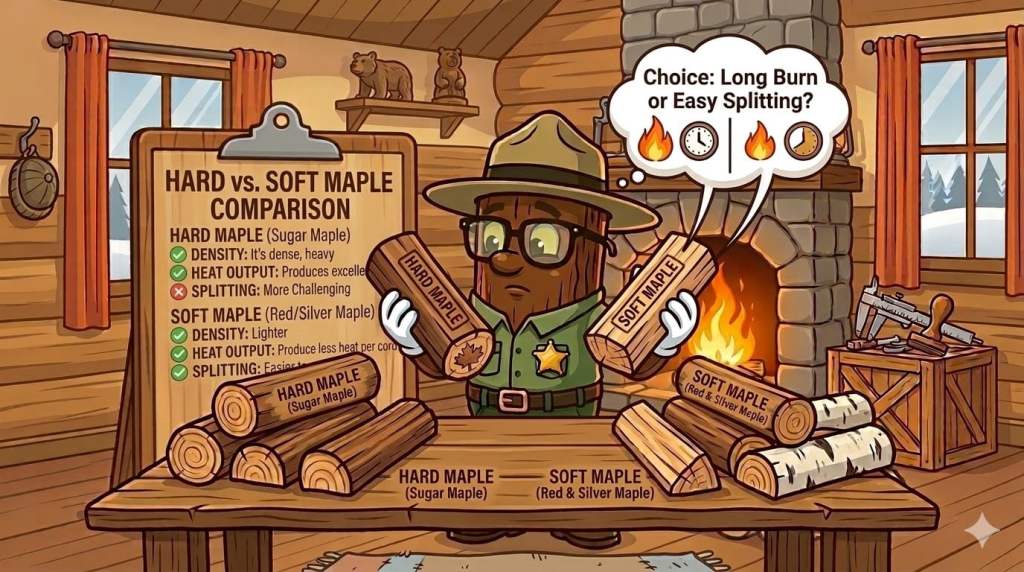
When people say “maple firewood,” they could be talking about several very different trees. The firewood industry splits maple into two categories: hard maple and soft maple. Understanding this distinction is the single most important thing to know before buying maple firewood.
Hard maple refers primarily to sugar maple (Acer saccharum). It’s dense, heavy, and produces excellent heat. If someone tells you they have “rock maple,” that’s the same thing — it earned the nickname because seasoned sugar maple is genuinely difficult to split by hand.
Soft maple includes red maple (Acer rubrum), silver maple (Acer saccharinum), and boxelder (Acer negundo). These trees are still technically hardwoods — the term “soft maple” refers to their density relative to sugar maple, not their classification. They’re lighter, easier to split, and produce less heat per cord.
Both categories grow abundantly in Wisconsin and the Upper Midwest. Sugar maple and red maple are among the most common species in southeastern Wisconsin forests, which is part of why maple shows up so frequently in firewood loads from this region.
How to Tell Them Apart
If you're looking at a stack of firewood and wondering whether you've got hard or soft maple, here are a few practical cues. Hard maple is noticeably heavier for its size — pick up two similarly sized splits and the sugar maple will feel denser in your hand. The bark on sugar maple tends to be thick with rough, irregular plates, while silver maple bark peels in long, shaggy strips.
Look at the end grain: hard maple has a tight, fine grain pattern, whereas soft maple looks more open and porous. One common point of confusion is boxelder. Most people don't realize boxelder is technically a maple (Acer negundo), but it's the lightest and lowest-heat species in the family — if the splits feel surprisingly light and the bark is thin and smooth, you're probably looking at boxelder, not sugar maple.
Maple Firewood Heat Output (BTU by Species)
Heat output for firewood is measured in BTUs (British Thermal Units) per cord. The numbers vary across sources because wood density depends on growing conditions, soil quality, and growth rate — a sugar maple that grew slowly on rocky soil will be denser and produce more heat than one that grew fast in rich bottomland. Rather than present a single number as fact, here are the ranges we’ve found consistent across forestry references:
| Species |
BTU/Cord (Range) |
Category |
Burn Time |
| Sugar Maple |
24–29 million |
Hard Maple |
Long |
| Red Maple |
18–24 million |
Soft Maple |
Moderate |
| Silver Maple |
17–22 million |
Soft Maple |
Moderate–Short |
| Boxelder |
14–19 million |
Soft Maple |
Short |
Source: USDA Forest Products Laboratory — Wood Heating Values (BTU Section)

For reference, oak typically falls in the 24–30 million BTU range and hickory around 27–30 million. Sugar maple holds its own in that company. Red and silver maple are a tier below — still useful, but you’ll burn through them faster on the coldest nights.
From our experience processing maple, the difference is obvious on the truck. A load of sugar maple is noticeably heavier than red or silver maple of the same volume. If the wood feels heavy and dense in your hand, you’re probably looking at hard maple.
How Maple Burns: Smoke, Coals & Aroma
One of the reasons maple has such a strong reputation as firewood is how clean it burns. When properly dried, maple produces low to moderate smoke that isn’t dense or acrid. The smoke has a mild, sweet scent — some people describe it as faintly syrupy, which makes sense given the tree’s sap content.
Coaling: Sugar maple produces excellent coals. A bed of maple coals holds heat well and can keep a wood stove warm for hours even after the flames die down. Soft maples produce decent coals too, though they don’t last as long.
Sparking: Maple is not a “snappy” wood. Unlike pine or cedar, it doesn’t throw sparks or pop aggressively. This makes it a safe choice for open fireplaces and for indoor use in general.
Creosote: Properly dried maple produces minimal creosote buildup. However, burning maple (or any wood) that hasn’t been adequately dried will increase smoke, reduce heat output, and accelerate creosote accumulation in your chimney. Moisture content matters more than species when it comes to creosote. You can test this yourself with a moisture meter — you want to be under 20% before burning.
Seasoning Maple Firewood (Or Skip It with Kiln-Dried)
If you’re air-seasoning maple, plan on 6 to 12 months for most species. Sugar maple is the slowest of the bunch — some sources recommend a full 1 to 2 years for optimal performance, though in our experience most sugar maple is burnable after 12 months if split and stacked with good airflow.
Red maple seasons faster, often ready in 6 to 8 months. Silver maple dries even quicker due to its lower density. The key factor across all maple species is splitting the wood while it’s still green. Green maple splits much more easily than dry maple — seasoned sugar maple in particular is notoriously tough to split by hand.
A few practical tips for air-seasoning maple:
- Split as soon as possible after cutting — more surface area means faster drying
- Stack off the ground on pallets or a rack with spacing between rows for airflow
- Cover the top to keep rain and snow off, but leave the sides open
- Target below 20% moisture content before burning — use a moisture meter to verify
The alternative is kiln-dried maple. At Best Burn, we kiln-dry our firewood at 260°F for 30 hours. This brings the moisture content below 17% — often lower — and eliminates the 6 to 24 month wait entirely. The kiln process also kills any bugs, mold, and diseases in the wood, which means kiln-dried maple is safe to store indoors without worrying about pests. If you’ve ever waited a full year for a stack of maple to season and still ended up with smoky, sluggish fires, kiln-dried wood solves that problem. Learn more about what kiln-dried firewood is and why it matters.
Kiln-dried firewood is also certified pest-free, which matters in Wisconsin where firewood movement is regulated to prevent the spread of emerald ash borer (Wisconsin DNR firewood rules).
Splitting Maple: What to Know
Maple’s splitting behavior depends heavily on the species and whether it’s green or dry. Green sugar maple splits relatively clean — it’s dense but mostly straight-grained. Once it’s seasoned, though, it earns the “rock maple” name. Dry sugar maple will fight back against a maul, and if the piece has any knots or burl, you’re in for a workout. A hydraulic splitter handles it without issue.
Soft maples — red and silver — are much easier to split in any condition. Silver maple in particular splits almost effortlessly. If you’re buying pre-split firewood, this is less of a concern, but if you’re processing your own, plan to split maple green and let it season after.
Cooking and Smoking with Maple Firewood

Maple is one of the more popular smoking woods, and for good reason. It produces a mild, slightly sweet smoke that enhances food without overpowering it. It’s a particularly good match for poultry, pork, vegetables, and cheese — anywhere you want a gentle smoke flavor without the intensity of hickory or mesquite.
Sugar maple is the preferred species for cooking due to its clean burn and higher heat. Red maple also works well. Many barbecue and wood-fired cooking enthusiasts use maple as their everyday smoking wood and reserve stronger woods like hickory for heavier meats like brisket.
Several of the wood-fired restaurants we supply in the Milwaukee area use maple alongside oak and cherry in their cooking operations. The sweet aroma of maple smoke is part of what gives wood-fired food its character.
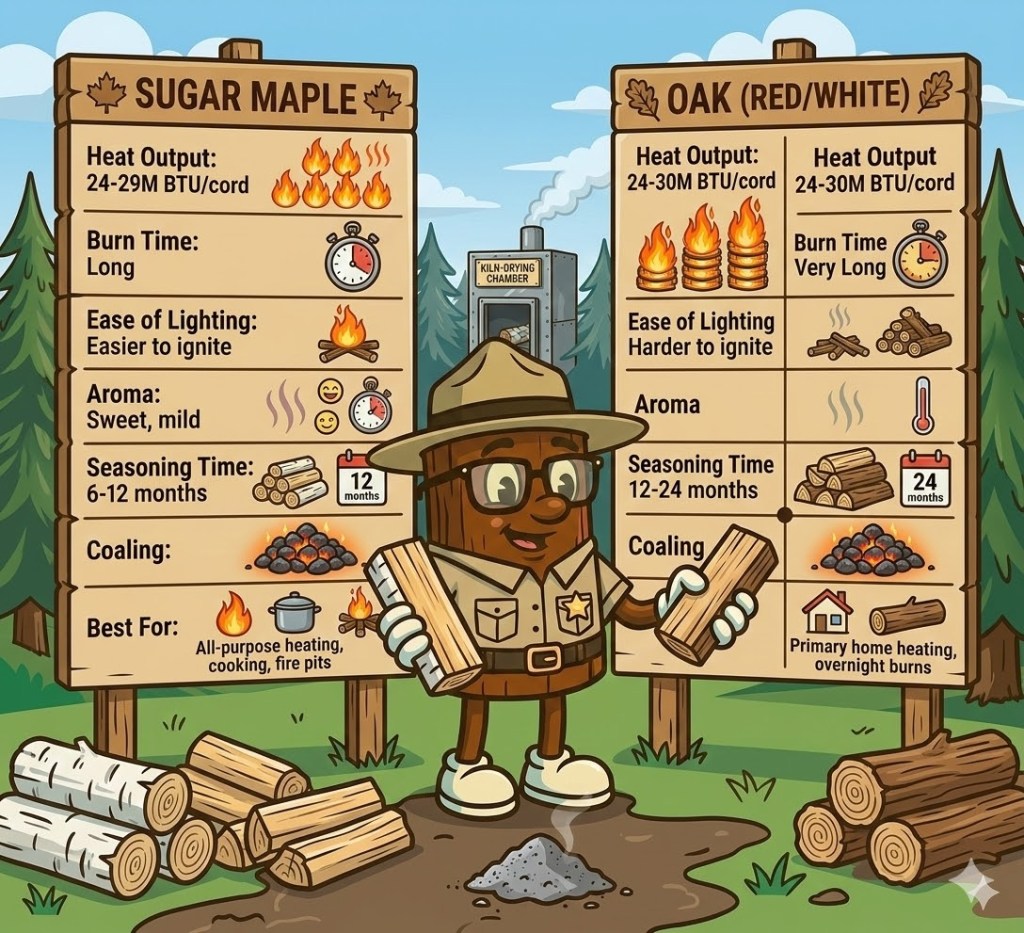
Maple vs Oak Firewood: How to Choose
This is the comparison most people are making when they search for maple firewood. Here’s the honest breakdown:
|
Sugar Maple |
Oak (Red/White) |
| Heat Output |
24–29M BTU/cord |
24–30M BTU/cord |
| Burn Time |
Long |
Very Long |
| Ease of Lighting |
Easier to ignite |
Harder to ignite |
| Aroma |
Sweet, mild |
Neutral to mild |
| Seasoning Time |
6–12 months |
12–24 months |
| Coaling |
Excellent |
Excellent |
| Best For |
All-purpose heating, cooking, fire pits |
Primary home heating, overnight burns |
The short version: oak firewood is the king of overnight fires and sustained home heating. Maple is easier to work with, lights faster, smells better, and seasons in roughly half the time. Both are excellent. In practice, most people benefit from burning both — and if you’re buying a mixed hardwood load, that’s exactly what you get.
Where Maple Fits in a Mixed Hardwood Load
Most firewood customers don’t buy single-species loads. They buy mixed hardwoods — and for good reason. A mix gives you the best of multiple species: dense, long-burning oak for the backbone of the fire, easy-lighting maple to get it going, cherry or birch for aroma, and hickory for raw heat.
Maple’s role in a mixed load is versatile. It’s denser than birch or cherry but lighter and easier to ignite than oak. It acts as the reliable middle of the lineup — good heat, good coals, pleasant smell, no drama.
At Best Burn, maple is sometimes included in our Mixed Hardwoods blend depending on what’s available from our local logging partners. Our mix typically includes oak, ash, cherry, birch, hickory, and maple in varying proportions based on current supply. All of it is kiln-dried to below 17% moisture, so regardless of species mix, it lights easy, burns hot, and produces minimal smoke.
Frequently Asked Questions About Maple Firewood
Is maple better than oak for firewood?
They’re close. Sugar maple and oak firewood have comparable BTU output, but oak generally burns longer and is better for overnight fires. Maple is easier to light, seasons faster, and has a sweeter aroma. For most people, a mix of both is ideal.
Does maple firewood burn clean?
Yes. Properly dried maple produces low smoke, minimal sparking, and relatively little creosote. It’s one of the cleaner-burning hardwoods available, which makes it a good choice for indoor fireplaces and wood stoves.
How long does maple take to season?
Air-seasoned maple typically takes 6 to 12 months, depending on the species and how it’s stacked. Sugar maple can take up to 12 to 18 months for best results. Kiln-drying reduces this to about 24 to 30 hours.
Is red maple good firewood?
Red maple is decent firewood — not top-tier, but solid. It’s easier to split and seasons faster than sugar maple, making it practical to work with. It produces moderate heat (18–24M BTU/cord) and burns clean. It’s best suited for shoulder-season fires or mixed into a load with denser wood.
Can you cook with maple firewood?
Absolutely. Maple is one of the most popular cooking and smoking woods. Its mild, sweet smoke pairs well with poultry, pork, vegetables, and cheese. Sugar maple and red maple are both good choices for cooking.
Is sugar maple the same as hard maple?
Yes. In most cases, sugar maple is what people mean by “hard maple.” In lumber and forestry references, hard maple is typically sugar maple (and sometimes black maple).
For firewood buyers, if it’s labeled hard maple, you can expect a denser wood that burns hot, makes strong coals, and performs closer to oak than the softer maples. Just make sure you’re not getting soft maple (like silver maple) under a vague “maple” label.
Is silver maple good firewood?
Silver maple is usable firewood, but it’s in the soft maple category, so it burns faster and puts out less heat than sugar maple or oak.
When it’s properly dried, silver maple is a solid choice for shoulder-season fires and recreational fire pits because it lights easily and seasons fairly quickly. Heat-wise, it’s roughly around 19 million BTU per cord when seasoned to typical burn-ready moisture levels.
Best use, mix it with denser hardwoods if you want longer burn times and better overnight coals.
Ready to Try Maple in Your Next Fire?
If you’re in southeastern Wisconsin, our kiln-dried Mixed Hardwoods blend is the easiest way to experience maple alongside other premium species — all dried to below 17% moisture, bug-free, and ready to burn the day it arrives. Check our firewood pricing and delivery page to see what’s available, or call us at (262) 746-7416.

Like this:
Like Loading...