How Much Firewood Is in a Cord? Sizes, Comparisons, and What to Order
A cord of firewood is 128 cubic feet, but that number only tells part of the story. This guide covers how a cord compares to a face cord, half cord, and bundles, what it actually looks like on delivery, and how to figure out how much to order.
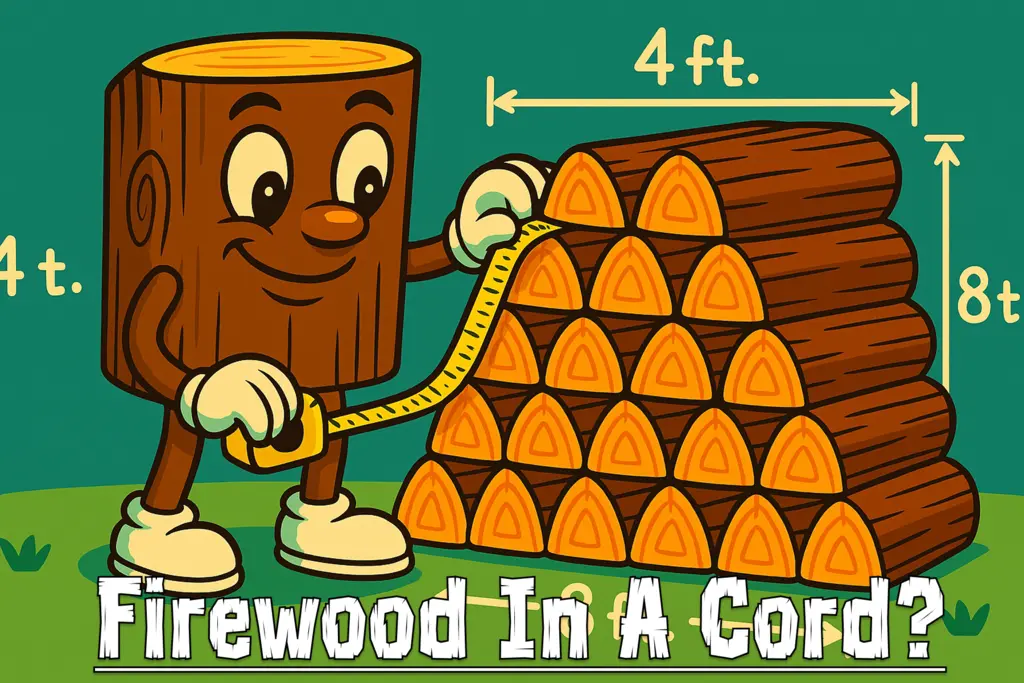
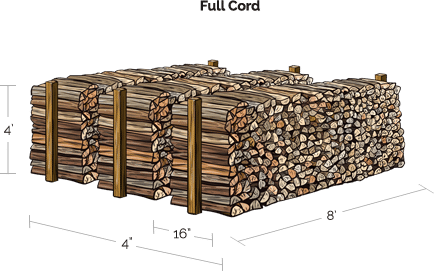
A full cord of firewood measures 4 feet high, 4 feet wide, and 8 feet long, totaling 128 cubic feet. If you already knew that, you are ahead of most people who call to place their first order. The confusion is not usually in the definition. It is in everything around it: how a cord compares to a face cord, what 128 cubic feet actually looks like when it lands in your driveway, whether a cord is even the right amount for your situation, and how to know you received what you paid for when the truck pulls away.
We run kilns and deliver firewood across SE Wisconsin. We answer these questions on every order we take. This guide covers all of it.
What Is a Cord of Firewood?
A cord is a standardized unit of firewood volume. The official definition, recognized across the United States and Canada, is a stack measuring 4 feet high by 4 feet wide by 8 feet long, totaling 128 cubic feet.
4 ft high × 4 ft wide × 8 ft long = 128 cubic feetTypical configuration: 3 rows of 16-inch logs stacked end-to-end, 4 feet tall, 8 feet across.
The 128 cubic feet figure is the space the stack occupies, not the volume of solid wood. Because split firewood pieces are irregular in shape, air gaps between them account for roughly 30 to 40 percent of the total stack. The actual solid wood in a well-stacked cord runs closer to 75 to 90 cubic feet. That gap matters when comparing prices between suppliers. Two sellers can both call it a cord, stack their wood with different density, and give you meaningfully different amounts of burnable fuel.
Firewood Quantity Units at a Glance
Firewood gets sold under a lot of different names, and not all of them are standardized the way a cord is. The table below covers the most common units, with dimensions, cubic feet, and piece counts based on 16-inch logs at a standard residential split size. The piece counts come from our own experience: we personally counted pieces during customer stack jobs over years of deliveries in SE Wisconsin, and these ranges held up consistently across species.
Unit
Dimensions (stacked)
Cubic Feet
Approx. Pieces
Best For
Full Cord
4 ft H × 8 ft L × 4 ft D (3 rows)
128
560–600
Primary heating, full-season supply, restaurant and commercial use
Half Cord
4 ft H × 12 ft L × 16 in D
64
280–300
Supplemental heating, regular seasonal burning
Face Cord (Rick)
4 ft H × 8 ft L × 16 in D
~42.7
180–200
Most common residential order, occasional to moderate use
Half Face Cord
2 ft H × 8 ft L × 16 in D
~21.3
90–100
A few weeks of fires, small storage footprint
Retail Bundle
Approx. 12 in H × 16 in L, varies
~0.75
4–6 pieces
Single campfire sessions, convenience use
Piece counts based on 16-inch log length at a standard residential split size. Numbers shift with split width and species density. Narrower splits produce more pieces per cord; wider splits produce fewer.
That table covers volume and piece count. For the other number people always ask about, weight, see our guide on how much a cord of firewood weighs by species.
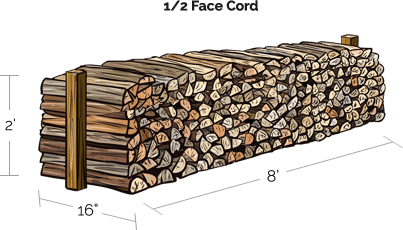
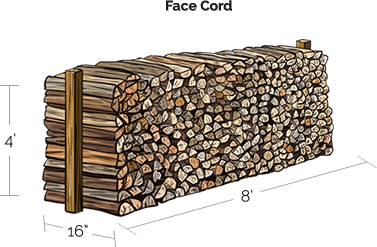
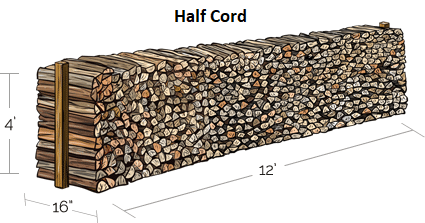
Here is what each size looks like when stacked:
Half Face Cord | 8 ft long × 2 ft high × 16 in deep | ~21.3 cu ft | 90–100 piecesFace Cord | 8 ft long × 4 ft high × 16 in deep | ~42.7 cu ft | 180–200 piecesHalf Cord | 12 ft long × 4 ft high × 16 in deep | 64 cu ft | 280–300 piecesFull Cord | 3 rows: 8 ft long × 4 ft high × 16 in deep | 128 cu ft | 560–600 pieces
How Big Is a Cord of Firewood? A Visual Reference
Dimensions help, but most people need to see it before the scale clicks. Here is what a cord looks like in real Wisconsin delivery situations.
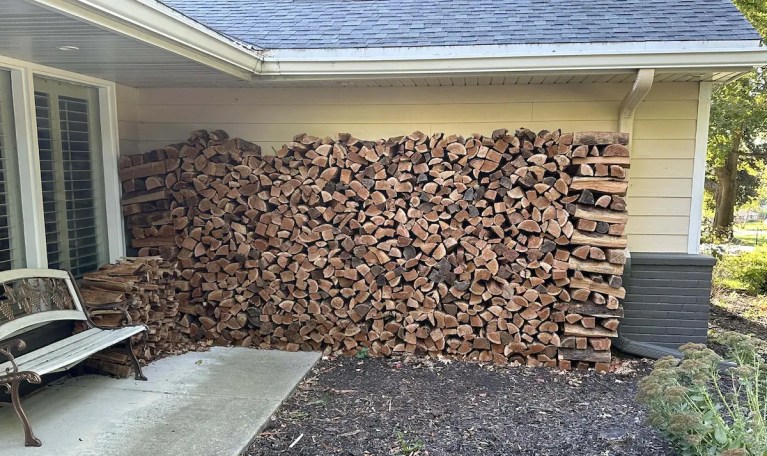
Full cord stacked against a home exterior. 8 ft wide, 4 ft high, 16 in deep.
Stacked against a house wall, a full cord of firewood covers roughly 8 feet of exterior siding at waist height. In most Wisconsin homes that is a solid stretch of garage wall or one full section of the house exterior. It is more wood than most people picture the first time they order.
Full cord of firewood dumped loose in a driveway before stacking. The pile depth is not visible from above.
A dumped pile always looks more manageable than it is. You cannot see what is buried underneath. After a few wheelbarrow loads in, when the pile has barely changed, that is when the volume becomes real. Customers who have never received a full cord before consistently underestimate the pile until they are halfway through stacking it.
Less than a full cord of firewood inside a two-car garage, SE Wisconsin. Remainder stacked outside.
Worth noting about that garage photo: that pile was not even a full cord of firewood, and it still took up most of the usable floor space in one bay. A full cord stored inside a two-car garage needs a dedicated section of wall space cleared for it. This is a common planning oversight we see from customers ordering for the first time. If indoor storage is limited, a face cord is usually the more practical choice.
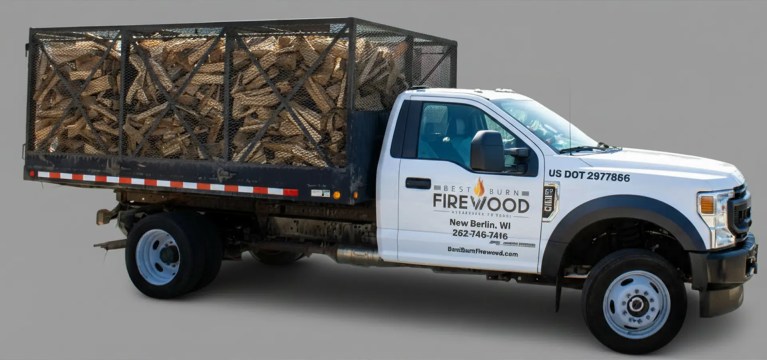
Best Burn Firewood delivery truck, New Berlin, WI. Truck capacity: 6 face cords (2 full cords). Load shown: 1 full cord loose.
The most common reaction we hear when a full cord arrives for the first time is some version of "that is a lot of wood." We have had customers tell us we delivered the wrong amount, that there was too much, that this could not possibly be one cord. In nearly every one of those situations, they had been ordering firewood for years and simply had never received the full amount they paid for from previous suppliers.
Full Cord vs. Face Cord vs. Half Cord: What Is the Difference?
A full cord of firewood is all three rows: 128 cubic feet, 4 feet deep, 8 feet wide, 4 feet tall. A face cord is one of those rows: about 42.7 cubic feet at 16-inch log length, or one-third of a full cord. A half cord is two rows, or 64 cubic feet, sometimes stacked as a single longer row to make the footprint more manageable.
Face cord is by far the most commonly ordered size among residential customers, both here in SE Wisconsin and at our Chicago-area location. It fits standard firewood racks, stores without taking over a garage bay, and is a practical amount for homeowners who are supplementing a furnace rather than running a wood stove full-time. When someone calls us asking for a cord, we follow up roughly half the time to confirm they mean a full cord and not a face cord, because the two terms get used interchangeably even though they are very different quantities. For a full breakdown of how face cords, full cords, and ricks compare, including how to normalize prices across sellers, see our face cord vs full cord guide.
Watch out for face cord depth variations.A face cord of 16-inch wood is about 42.7 cubic feet. A face cord of 12-inch wood is about 32 cubic feet. Two sellers can both call it a face cord and deliver very different amounts. Always ask for the log length and cubic feet before you commit to a price.
One note on 12-inch lengths: while 16 inches is the industry standard for most fireplaces and wood stoves, 12-inch pieces are increasingly common for smokeless fire pits, which have smaller fireboxes. If you are ordering for a smokeless pit, confirm the log length before ordering. It makes a real difference in both fit and cost per unit.
How Many Pieces of Firewood Are in a Cord?
The number you will see cited most often online is 600 to 800 pieces per cord of firewood. Our own count puts the real figure lower for standard residential split sizes: roughly 560 to 600 pieces per full cord at 16-inch lengths. We counted this personally during customer stack jobs in the early years of our operation and revisited the numbers periodically as a check. A face cord consistently came out to 180 to 200 pieces. A half face cord ran about 90 to 100 pieces.
That number moves depending on split width and species. Narrower splits mean more pieces per cord. Wider pieces mean fewer. A cord of dense oak will have fewer pieces by count than a cord of lighter birch at the same split dimensions, because each oak piece is heavier and takes up more volume per unit. For a full breakdown by split size and species, see our firewood species and burn guide.
How Many Bundles Are in a Cord of Firewood?
A standard retail firewood bundle, the kind sold at Kwik Trip, Sam's Club, or most campground stores, holds approximately 0.75 cubic feet of wood. Here is how that translates to cord equivalents:
At three to five bundles per fire, burning two to three times a week through a Wisconsin winter puts you well past 100 bundles for the season, often closer to 150. Buying by the cord or face cord brings the per-fire cost down substantially, and the wood quality is typically better than what sits in a convenience store parking lot through rain and frost. For a full comparison of bundle math and how to convert between units, see our firewood bundles page.
How Much Firewood Do You Actually Need?
This depends more on how often and how long you burn than it does on what size you order. Here is what we see from actual residential customers across SE Wisconsin.
Quick planning referenceOccasional use (a few fires per month): half face cord or less for a full season Regular use (2–3 fires per week, evening burns): one face cord lasts 6–8 weeks. Plan on 2–3 face cords for a full Wisconsin winter as a supplement. Primary heating (wood stove running daily): 3–5 full cords for a Wisconsin winter, depending on home size and insulation.
For a complete guide to estimating how much firewood you need for your specific situation, see our firewood ordering guide.
What Does a Cord of Firewood Cost?
Pricing varies by region, species, drying method, and delivery distance. Nationally, a full cord of mixed hardwood typically runs between $200 and $500. Kiln-dried wood carries a premium over air-seasoned because of the real investment in equipment and energy, and because the moisture content is consistent and verifiable rather than estimated. For current Best Burn Firewood pricing by cord and face cord, including delivery options across SE Wisconsin, visit our firewood pricing and ordering page.
How to Know You Got a Full Cord on Delivery
The only reliable way to verify a delivery is to stack the wood and measure before the truck leaves. Be cautious of sellers who quote in terms like "truckload," "pile," or "rick" without defining dimensions.
How to verify before the truck leaves:A full cord stacked should be 8 feet wide, 4 feet tall, and 4 feet deep (three rows of 16-inch logs). If the dimensions come up short, you were shorted. A rick typically means face cord in most markets, but log length varies between suppliers, so two ricks from two companies can have very different cubic foot totals. Measure in cubic feet, not in names.
Why Kiln-Dried Firewood Performs Better by the Cord
A cord of green wood and a cord of kiln-dried firewood occupy the same 128 cubic feet. They do not deliver the same heat output.
Green or poorly seasoned wood can hold 40 to 50 percent moisture by weight. Before it burns efficiently, the fire has to boil off that water first. The result is more smoke, lower heat, and significantly more creosote buildup in your flue. Every BTU spent evaporating moisture is a BTU that does not reach your living room.
Best Burn Firewood kiln specs265°F for 24–32 hours per load. Output: dried to a consistent 15% moisture. USDA and WDATCP certified, Heat Treatment number 2019086.
The same standard holds across every face cord and full cord we deliver, from residential customers in Waukesha County to the 20 wood-fired restaurants we supply across SE Wisconsin, including Smoke Shack in Milwaukee and Council Oak at Hard Rock Casino in Bristol. When a kitchen is burning through a cord of wood in a single service shift, consistency in moisture content is not optional.
FAQ: Cord of Firewood
What is a cord of firewood?
A cord of firewood is a standardized unit of volume equal to a stack measuring 4 feet high, 4 feet wide, and 8 feet long, totaling 128 cubic feet. Most firewood is cut to 16-inch lengths, so a cord is typically three rows deep.
What is the difference between a cord and a face cord?
A full cord is 128 cubic feet, stacked three rows deep at 16-inch log length. A face cord is one of those three rows: approximately 42.7 cubic feet at 16-inch depth, or one-third of a full cord. Face cord is the most common residential order size.
How many pieces of firewood are in a cord?
At 16-inch log length and a standard residential split size, a full cord typically contains 560 to 600 pieces. A face cord runs about 180 to 200 pieces. A half face cord comes out to around 90 to 100 pieces. These numbers shift based on split width and species density.
How many bundles of firewood are in a cord?
A standard retail bundle holds about 0.75 cubic feet. A full cord of 128 cubic feet equals approximately 170 retail bundles. A face cord equals about 57 bundles, and a half cord equals about 85 bundles.
How long does a cord of firewood last?
At two to three fires per week for typical evening burns, a face cord lasts about six to eight weeks. A full cord used as supplemental heating at that pace would last four to six months. For primary wood heat, plan on three to five full cords for a Wisconsin winter, depending on home size and insulation.
What is a rick of firewood?
Rick is another term for face cord in most markets: a single row of firewood 4 feet high, 8 feet long, and one log-length deep, usually 16 inches. The term is not legally standardized, so always ask for the specific log length and cubic feet when comparing quotes.
How much does a cord of firewood cost?
Nationally, a full cord of mixed hardwood typically runs between $200 and $500. Kiln-dried wood costs more than air-seasoned because of the drying process and the consistency it delivers. Local pricing varies by species, delivery distance, and time of year.
How do I know if I received a full cord on delivery?
Stack the wood and measure before the truck leaves. A full cord stacked should be 8 feet wide, 4 feet tall, and 4 feet deep (three rows of 16-inch logs). If the dimensions come up short, you were shorted. Avoid sellers who use vague terms like "truckload" or "pile" without specifying dimensions.
Does kiln-dried wood change how long a cord lasts compared to seasoned wood?
Yes. Kiln-dried wood burns more completely and produces more usable heat per piece because each piece is burning at full efficiency from the start rather than spending energy evaporating moisture. You will often get more fires out of a cord of kiln-dried wood than a cord of green or poorly seasoned wood at the same piece count.
How many cords of firewood do I need for a Wisconsin winter?
For occasional to moderate use: one to two face cords for the season. For regular supplemental heating with a fireplace: two to three face cords. For primary heat with a wood stove running daily: three to five full cords, depending on home size and insulation. When in doubt, start with a face cord, track how long it lasts, and order accordingly.
Know what size you need? View current pricing and schedule delivery across SE Wisconsin.
Tyler M is the Co-Founder of Best Burn Firewood in Wisconsin, where he works directly in sourcing, processing, kiln-drying, packaging, and delivering firewood for residential and commercial customers. His writing is based on first-hand experience with wood species performance, moisture control, storage, and burn quality, including how different hardwoods behave in fireplaces, wood stoves, and outdoor fires. Tyler publishes practical guides to help customers choose the right firewood and burn it more safely, cleanly, and efficiently.
best firewoodburncord of woodfirewood measurementsheatHow Much Firewood is in a Cordkilnkiln driedkiln dried firewoodone cordstackwoodwoods
Related Blog Posts
Hickory Wood: A Complete Guide to Smoking and Burning
Hickory makes the boldest barbecue smoke and burns hot enough to heat a home, but it is the easiest popular wood to get wrong. Here is how to smoke with it, burn it, and skip the bitter-smoke mistakes.
A cord of firewood can weigh anywhere from about 3,000 to over 5,000 pounds, and most of that swing is water, not wood. We weigh every load that comes through our yard, so instead of a vague range, here are the real weights by species, green versus kiln-dried at 15%. You will also get a straight answer on what a full cord does to your truck before you try to haul one.
Face Cord vs Full Cord vs Rick: What You're Actually Buying
Face cord, full cord, rick: three terms that get used interchangeably by sellers, but they are not the same thing, and the difference can cost you real money. One of them is legally defined. The others are not. Here is how to tell them apart, compare prices across sellers, and know exactly what you are getting before the truck pulls away.
Pecan Wood for Smoking: Flavor Profile, Meat Pairings, and How It Burns
Pecan wood for smoking delivers a sweet, nutty flavor that sits right between fruitwoods and hickory on the intensity scale. It burns hot, produces solid coals, and holds up across a wide range of proteins without overpowering them. Here is everything you need to know about how it performs, which meats it works best on, and how it stacks up against hickory.
Best Firewood for Pizza Ovens: Heat Control + Coal Management
Kiln-dried oak is the best wood for a pizza oven, but species choice is only half the equation. Heat control and coal management are what actually separate a perfect crust from an inconsistent one. Here is what Wisconsin's top wood-fired restaurants use, and how they do it.
Is Oak Good Firewood? Heat Output, Burn Time & Seasoning Tips
Oak is the go-to firewood for overnight burns and serious home heating — but it carries more moisture than almost any other hardwood, and red oak and white oak don't perform the same. We break down BTU by species, what it actually takes to dry oak properly, real kiln data from our operation, and why restaurants request oak more than any other species.
Is Maple Good Firewood? Heat Output, Burn Time & What to Expect
Maple is one of the most common firewood species in Wisconsin — but sugar maple and silver maple perform very differently. We break down the real BTU numbers by species, how maple burns, seasoning vs kiln-dried, and where maple fits in a mixed hardwood load.
Is Birch Good Firewood? Heat Output, Burn Time, What to Expect
Birch is good firewood for fireplaces and wood stoves, offering high heat and a steady burn. Learn heat output, burn time, and how birch compares to hardwoods.
Safely Transporting Firewood: Key Rules You Must Know
Have you ever considered the type of firewood you use for your fireplace or grill? The quality of your firewood can significantly impact your fire experience, whether it’s the ease of lighting the fire, the longevity and intensity of the burn, or even the aroma produced. Enter kiln-dried firewood, a premium firewood option that guarantees an optimal burn experience for any occasion.
Is Ash Good Firewood? Heat Output, Burn Time & What to Expect
Ash is one of the easier hardwoods to work with, it splits clean, dries faster than oak, and burns well across a wide moisture range. Here's what the BTU numbers actually look like, how white ash and green ash compare, and what the emerald ash borer situation means for availability in Wisconsin
Cleaner Fires: Using a Moisture Meter for Firewood
Ensure cleaner, more efficient fires with a moisture meter for firewood. Learn how to choose the right meter to improve your wood-burning experience today!
Wondering how to start a fire with wet wood? Our fire-loving mascot Woody is here to show you the tricks, tools, and tips to turn damp logs into a crackling success. Let’s fire it up... rain or shine.
Why does firewood pop during burning? Firewood pops during burning because moisture and resin trapped inside the wood turn into steam when heated, creating pressure that bursts through cracks. Read the article below, to find out why your firewood is popping!
What Firewood Is Best for Burning In Your Fireplace?
From our experience, Oak and Hickory are the best firewood choices for a long-lasting, efficient burn in your fireplace. But every home and fire is different—read our guide below to see which firewood is best for your needs! 🔥
Why Should I Choose Kiln Dried Firewood? Learn what Kiln Dried Firewood is, and Why You Need It
Have you ever considered the type of firewood you use for your fireplace or grill? The quality of your firewood can significantly impact your fire experience, whether it’s the ease of lighting the fire, the longevity and intensity of the burn, or even the aroma produced. Enter kiln-dried firewood, a premium firewood option that guarantees an optimal burn experience for any occasion.
Firewood 101: Discover The Best Firewood to Burn for Maximum Heat and Efficiency
Ever wondered why some fires burn brighter, hotter, and longer than others? The secret lies in choosing the best firewood for your specific needs. This comprehensive guide of wood burning tips will help you discover the best firewood to burn, based on their characteristics, ideal uses, and proper preparation to maximize heat, efficiency, and create a cozy atmosphere.
After experiencing firewood deliveries filled with dirt and debris, we now hand-pick and load each order to ensure you receive clean, high-quality wood. This guarantees the exact amount of wood without the extra mess.
Call us at any time of the year, whether it's in the hot summer or freezing winter.
100% kiln dried Wisconsin Firewood for Sale.
Stacking of your firewood delivery upon request
FIREWOOD Delivery To following areas
South Eastern Wisconsin and Waukesha County
Firewood delivery in South Eastern Wisconsin and Waukesha County